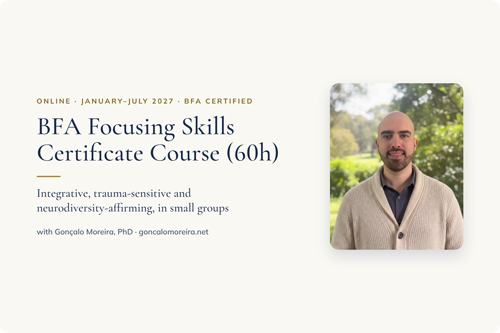
Integrative, trauma-sensitive and neurodiversity-affirming
When: Weekly, January to July 2027: Group A from Monday
18 January, Group B from Friday 22 January
Time: Group A: Mondays 5.30–8.30pm · Group B: Fridays
10am–1pm (Irish time). Choose one group.
Free tasters: Monday 23 or 30 November, 5.30–7.30pm, or
Friday 27 November or 4 December, 10am–12 noon (Irish
time)
Where: Online via Zoom
Host: Gonçalo Moreira, PhD
Learn a gentle and flexible approach to Focusing, with nervous-system
regulation woven through every session, designed to work for different profiles
(for example, high sensitivity, neurodivergence, trauma and overwhelm), in a
small group (max. 7 participants)
Free online taster (about 2 hours): a shorter version of a real class (welcoming the participants, a lead-in, a check-in, a presentation where I introduce Experiential Focusing, my approach and the course, a moment for questions, a short practice in pairs, and sharing). Monday 23 or 30 November, 17:30–19:30 UK time, or Friday 27 November or 4 December, 10:00 - 12:00 UK time.
Many of us learned to push through: to override the tiredness, the dread, the flinch, and get on with it.
This course offers another way: listening, kindly and without hurry, to what is there, allowing it to find its own next steps. And in Focusing, listening is sometimes simply quiet attention; at other times, what you sense
wants to find expression.
However, listening in the Focusing way needs a particular inner climate: enough safety and support that you can meet what you find with genuine care, curiosity and patience, instead of being swept into it or pushing it
away.
So we begin there, making space for whatever helps you feel safe, supported and held, in your own way and at your own pace.
“To work on something bad, it helps to recall what is good, where I am sound. […] my body will
work better on what is wrong, if I first let it feel whole and sound, and then turn to what is
wrong.”
Eugene Gendlin (1983)
From that more resourced presence, listening to what is present can happen, without rushing or forcing it, so that next steps can come.
Support can come in many ways: for example, through what you see, hear or touch around you, the chair beneath you, a movement, an image, a memory, a pleasant sensation, a warm feeling. And what you sense can find expression in many ways too: for example, silence, words, movement, drawing, writing, music.
This is what makes the approach integrative: it tries to bring together these avenues of sensing and expression.
From Somatic Experiencing® and other trauma- and nervous-system-informed approaches, I bring in three ideas. Resourcing: finding, and coming back to, what supports you. Titration: approaching what is difficult in
steps small enough that you can stay anchored in felt safety and support. And pendulation, as I understand it: staying anchored in what supports you while turning towards what is difficult, as much and for as long as
feels OK, without losing your footing in felt safety.
We also learn to recognise survival responses (for example, fight or flight, freeze, collapse), and what can help when they start to outweigh the sense of being OK, safe and supported. All of this is an intention and a
learning journey: it’s perfectly fine if it doesn’t happen at first, or for a while.
The course is neurodiversity-affirming: differences in how you sense, process and express are welcome as they are, not something to fix, and both the way of doing Focusing and the practical side of taking part in the sessions (moving, the camera, the chat, the pace) can adapt to you. Also, you can share any diagnoses you might have (with me or the group) if you think it might help, although there’s no requirement to do so.
At A Glance
- Group A, Mondays: 17:30–20:30 UK and Irish time (18:30 Paris, 12:30 New York, 09:30 Los Angeles), 18 January – 28 June 2027
- Group B, Fridays: 10:00–13:00 UK and Irish time (11:00 Paris), 22 January – 2 July 2027
- Format: 20 weekly sessions of 3 hours (60 hours) in five modules of four sessions, with a break week
between modules. Online (Zoom), in English. The Zoom link is sent to you after you register. - Five modules: Settling, safety and the nervous system · The language of the inner world · The art of gentle
companionship · The inner places that protect us · Integration into everyday life - Level: beginners welcome; no previous experience needed. It is a training course, not psychotherapy.
- Certificate: the Focusing Skills Certificate from the British Focusing Association (BFA) is included. If you’d
like, I can also recommend you for TIFI’s Proficiency in Focusing Partnership Award (this needs TIFI
membership plus a one-time fee). - If you’d like to experience Focusing with me before deciding: one individual session (50 minutes) at the
course rate (€35)
Class size
7 participants at most, together for the whole course (limited numbers).
Cost
One payment of €540 (about £450 or US$600) if you register and pay by 15 December 2026, €570 after that; or €600 in five instalments of €120.
Arrangements for registration and payment
A free call with me (about 30 minutes) is the first step, to check together that this is the course you want and that it fits where you are now: book it here. The group stays together for the whole course, so registering means committing to all of it.
Booking, the full outline, every date and the terms are on the course page.
About the Facilitator
I first learned Experiential Focusing in 2009, with Kay Hoffmann. I came looking for a way to solve problems, and found something deeper: the experience of being truly listened to, without having to fix anything. Over
the years, and especially through my PhD (six years exploring Focusing as the basis for creating music), it became my compass for finding my next steps.
I am neurodivergent myself, and the usual advice to relax or take a deep breath often didn’t work for me, so I built this course as the gentle and flexible container I wish I had had. In 2026 I taught the first edition of this course to four small online groups (20 participants), after assisting on Kay Hoffmann’s BFA Focusing Skills Certificate course in 2023.
Focusing Trainer (TIFI) · Focusing Teacher (BFA) · Somatic Experiencing® Practitioner · PhD on Focusing and music creation (Universidade NOVA de Lisboa)
Contact
- Email:
This email address is being protected from spambots. You need JavaScript enabled to view it. - WhatsApp: +351 914 783 304
- Free call (about 30 minutes): book it here
- YouTube: @GonçaloMoreiraPhD
I’m also on Instagram, Facebook and LinkedIn.