Our Focusing Refresher evenings have been running since last September. Each month we've had an opportunity to sense into a different aspect of Focusing in partnerships. We're very appreciative of our Focusing trainers who facilitated these evenings. The last Refresher session (and our last zoom session) will take place on Monday 30th June. Fiona O'Meara will facilitate The Power of Prompting: Ways of reflecting without interrupting the process.
Earlier this year our new Guidelines for Zoom Focusing Sessions were shared by email with all our members. The guidelines, which can be found on our website (by clicking here), were drawn up by the committee in order to nurture and maintain a sense of safety within our community and to promote respectful connection. If you haven't already done so, please take time to read the guidelines.
Finally, we are very excited to host a Children and Focusing Introductory day in Dublin with Rene Veugelers and Elaine Goggin on June 28th. We invite you to support this initiative in whatever way you can - by attending or by sharing the news of the event with your family/friends/colleagues and on social media. This day is open to everyone including those who don't know Focusing so this is a great opportunity for us all to spread the word about Focusing within our communities and to reignite interest in Focusing with Children in Ireland.
Where ever you are in the world, we wish you a beautiful summer and look forward to reconnecting with you on line in September.
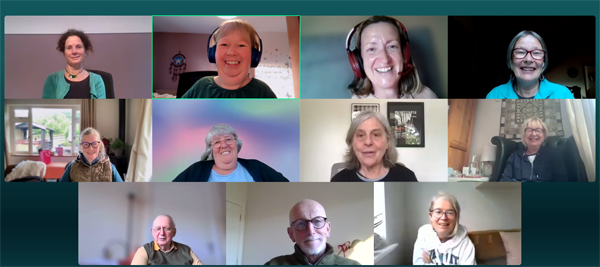
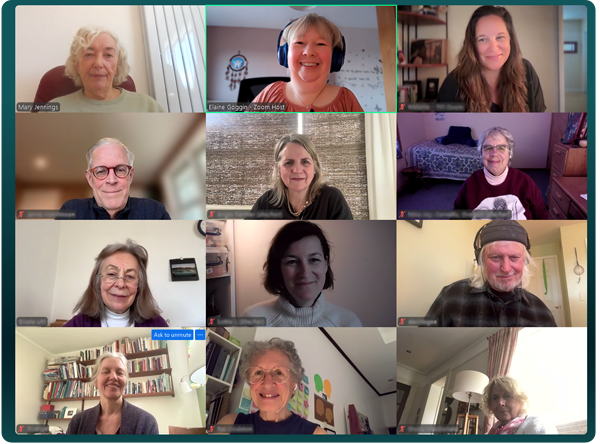
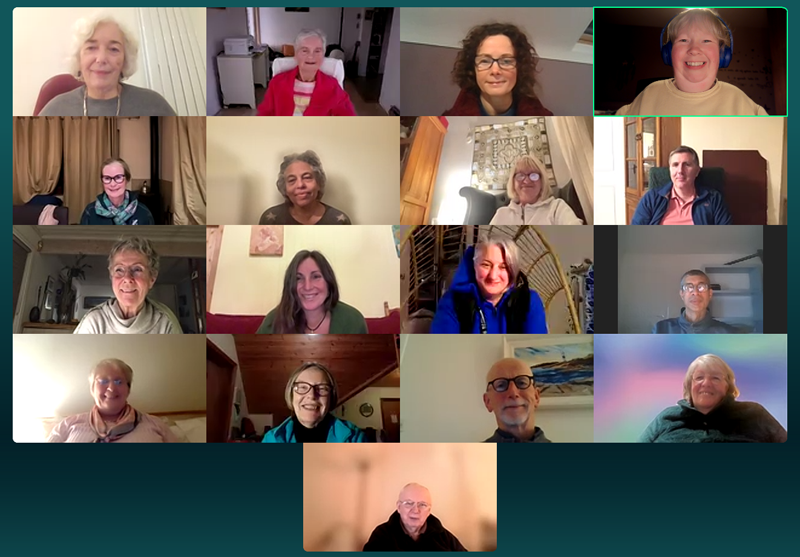
Photo from our May Skills Refresh Evening with Therese Ryan
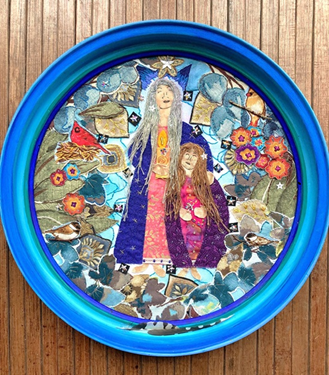
It was a during a Focusing session when I described that I felt I was stuck in a maze .. not knowing if I should go forward or back. But I also seeing that there was ahead of me a hand reaching out to help pull me through. When I imagined who’s hand it was .. I knew it was my own. My wiser, compassionate self was there to pull me out of my stuckness.
So here I am in two different forms. The wiser, surer self, holding a candle to light the way and placing her hand on the shoulder of she who feels fragile or lost. And again, here I am, leaning into my wiser self, holding all my love in my hands, trusting she will care for it. We are both surrounded by birds, leaves, flowers and stars.
When do you meet your own wiser self? How does she or he show up in your life? What do you see in their eyes?
Denise Durocher, May 2025
by Tom Larkin
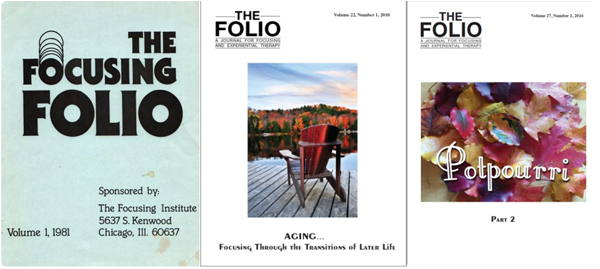
As Michael Caine would have said (in a cockney accent) “Not a lot of people know that” Know what? About The Folio! The what? The Folio!
The Folio certainly is a hidden treasure – it was a journal published irregularly between 1981 and 2016 by The International Focusing Institute (TIFI). The early editions were largely a collection of articles written by Focusing people about a variety of topics related to the theory and practice of Focusing, now scanned, collected together and available on the TIFI website. The later issues adopted a more thematic approach with each issue concentrating on a particular area or topic from a Focusing perspective. These are also available as pdfs on the TIFI website. In these later Folios the articles are easily accessible and can be read individually. Topics included, among very many others:
- Focusing and Spirituality
- Focusing and Fear
- Focusing and Medicine
- Focusing with Children
- Thinking At the Edge
- Interactive Focusing
etc.
The full list of what is available to view in pdf form is at https://focusing.org/folio
Each issue contains a broad range of views, perspectives, experiences and reflections, some theoretical, some philosophical, some personal, some practical and all interesting and informative. The perusal through the contents pages of each issue will reveal a wealth of fascinating articles by some of the big names in Focusing including Eugene Gendlin and Ann Weiser Cornell.
This will be especially useful for people engaging in any research or academic study of Focusing or for someone who wishes to follow a thread over time e.g. articles about Focusing and Nature or Focusing and the Body. Or for the casual, curious Focusing reader, you can just dip into an issue and perhaps uncover some gems of insight and wisdom. Whatever the motive you are sure to find something worthwhile and of interest among them.
Besides the special issue on ‘Thinking At The Edge’, some of my personal favourites, to name just a few, include:
- Resonant Sensing for Peace – Listening to Our Planetary Being by Eric Lorup and Bruce Nayowith in Vol 27 Part 2
- Heartfelt Connections by Kevin McEvenue in Vol 26
- The Implicit transformational Power of the Background Feeling in Focusing by Marine de Fréminville in Vol 21
- A Seventh Movement: The Action Step by Atsmaout Perlstein and Bilha Frolinger in Vol 21.
In fact, Vol 21 was a particularly rich volume. It was the Tribute Issue; Celebrating 30 years of Focusing 1978 – 2008.
Accessing The Folio: All Folios are available for free to paid members of TIFI however you will need to be logged in to view them. There are still some Folios are available for purchase in hard copy. Contact
by Clare Myatt
If you’re reading IFN’s wonderful newsletter, you’re probably already a devotee (is that the right word?) of focusing. I most definitely am a devotee (it’s the right word for me). To say it has been transformational in my life sounds rather grandiose, but that’s the truth of it.
 From the first training with Jerry Conway many years ago, to the latest seminar given by Ann Weiser Cornell at the Somatic Approaches in Therapy Summit [April 2025], my life is pervaded by Eugene Gendlin’s seminal philosophy. It’s a bit like the red mini effect - that tendency to see a red mini then see almost nothing but red minis thereafter. Apparently, this is the frequency illusion, more accurately described as the Baader-Meinhof Phenomenon.
I recently attended one of Dr. Jim Feil’s online workshops on the topic of entanglements and getting oneself disentangled. The step from entangled to disentangled involves - you’ve guessed - pausing, taking a step back, finding exactly the right distance to be with entanglement. Hm, I thought, focusing.
I also attended one of Dr. Richard Schwartz’s online workshops on Internal Family Systems. He provided a demonstration with someone working with the part of her that says yes too quickly. In the process of the demo she identified another part which is annoyed because it would prefer to have time for more fun. Then she spent time holding both until such time as they were willing to talk to one another. Sound familiar? Looks like focusing to me.
The essence of focusing appears in poetry as well and thanks to IFN’s Marie McGuigan, I’ve found Julia Fehrenbacher’s poem The Most Important Thing. I think she’s captured the essence of focusing, as did Rumi in The Guesthouse, and John O’Donohue in For a New Beginning.
As I wrap up this review of the red mini effect, I’d like to share four words with you: “sneaky wee” and “sneaky pooh.” They do make me smile. Michael White was an Australian therapist working with children who wet and soiled the bed, and he created something called narrative therapy. His approach sought to externalise the problem - instead of the child being the problem, the problem was the problem. What a difference that made! It reminds me of Gendlin’s making space between the self and the problem:
“You welcome anything that comes…but you stay a little distance from it. You’re not in it, but next to it…you are neither running away or going into it…you sense there is space between it (felt sense) and you. You are here and it is there. You have it, you are not it.” [emphasis added]
I feel so blessed to have the red mini effect of Gendlin’s philosophy in my life. Everywhere I look, there he and his wisdom prevail. I also appreciate being part of the Irish Focusing Network - a beautiful and supportive community of like-minded folk - thank you.
BIO
Clare Myatt, LL.B., M.A., is an experienced practitioner using the lens of somatics/embodiment to inform her integrative coach-therapy. She was certified as a Focusing Practitioner in 2018, in Focusing Oriented Therapy in 2023 and published her first book in 2019 Love & Imperfection: A Therapist’s Story.
www.claremyatt.co.uk
by Mary Jennings
May 2025
Bruce Gibbs, a student of Gene Gendlin, taught Focusing by a method he calls ‘instances’ rather than through Gene’s better known six steps. He would start his first class by asking how they might react to seeing the flashing lights of a police car right behind them in the rear-view mirror. Straight away, everyone was able to identify the visceral body-feel and the feeling-feeling of that! They recognised that sense of ‘something’ that was not, as yet, quite clear: a felt sense was forming.
He would start by first helping them elicit a felt sense, as in the example above, then support them to explore further as they became more aware of their own capacity to sense more. They were learning Focusing by exploring something that they already knew, rather than starting by having to learn some unfamiliar technique such as the Gendlin six steps.
Lessons from Bruce Gibbs’ approach
Suppose we were to follow Bruce’s example and, in everyday conversations, be in there with the notion that felt-sensing is frequently, but not always, in play and if it is not, it can be encouraged. In other words our default mode is, ‘people are felt-sensing beings - let’s treat them like that.’
You might recognise that people are in this felt-sensing mode by noticing hesitations, uncertainties (a fuzzy edge)… they may pause…. they might use phrases like, “it’s like that time when,” or use metaphors or similes – “it’s like a fly you can’t catch – that kind of feeling…”. They are searching for the felt sense of what this is all about.
In this situation, you know they are in what philosopher and Focusing teaching, Greg Walkerden, calls ‘experiential depth;’ in effect they are felt-sensing, using this innate capacity of human beings quite naturally. If it feels right, you might use some of the following ‘steps’ as gentle invitations to them explore their felt sense. These include:
Six things you can do or say to support the felt sense to unfold in others:
- “Can you say more about that….”
(when you are noticing some hesitation)
- “It’s like a fly you can’t catch…”
(Saying back the key feeling/sensing/crux words in reflective listening)
- “In the example/story you are speaking about, it is a kind of … flexibility.. you are hoping for – something like that or…?”
(giving your best guess – knowing you are correctable).
- “Have you seen that kind of flexibility you are speaking about in other situations?”
(looking for more examples or instances of what they are pointing to; this helps to allow a felt sense to come more into focus and brings greater clarity)
- “What would you like this word –‘ flexible’ - to mean here?”
(knowing words are in context and they can carry many meanings – you are allowing the person to mean what they say, here, in this situation)
- “What comes to me about all this is….
( tentatively offer something that comes from your felt sense of the situation they are describing – how their experience lands with you: It’s not advice, not suggestions, definitely not ‘let me tell you my story’! Instead, you are offering an empathic moment, one human being in interaction with another, and the person may go deeper…)
Of course, you would not use all of these ‘steps’ in any one conversation. They are offered here as a way to experiment with bringing a focusing-orientation into everyday conversations, particularly when you have the clear sense that the other person in the conversation is in a natural, ‘felt-sensing mode’ or at some level of ‘experiential depth.’
It may support them to go deeper, or to facilitate them to pause, to spend time with an often-elusive ‘felt sense of all that,’ all the while having a natural conversation.
It becomes easier when we have felt-sensing as part of our way of being. This is not about being performative or trying too hard. It has to be natural – and that comes with time and practice.
At times, this approach may be totally inappropriate or confusing for the other person. It has to come from a place of deep presence and deep listening. Below are some guidelines to help you consider when to use/not use these ‘six steps.’
A framework to guide you
Greg Walkerden has some good advice on how to go about bringing these ‘steps’ into a conversation. A summary of the framework he has developed is below:
- Wait to see if something that seems helpful comes from your felt sense
- Be tentative, make it easy for the person to NOT follow your lead
- If they don’t, relax into appreciating that it seemed like a helpful suggestion, but it’s ok if it is not
- If you feel a soft 'no' to something you are doing or are about to do, pause, back up, and freshly consider a way forward
The final word: try it, experiment, you might find your conversations become a lot more interesting!
Mary's 3 week course was well received recently with The International Focusing Institute
Each Newsletter will explore an aspect of the Focusing World you may not be familiar with. In this edition we will explore the world of Whole Body Focusing.
We are delighted that WBF Trainer Addie Van Der Kooy, took time to write a piece on Focusing with your whole body.
This writing starts with a deep appreciation for Kevin McEvenue, who about 45 years ago, intuitively began combining his work as an Alexander Technique practitioner with his work as a Focusing trainer. He called it Wholebody Focusing (WBF).
For instance, the observation by F. M. Alexander that the body has to come alive as a whole in order for change to happen in a part of the body, has deeply shaped an emphasis in WBF on taking time to become aware of your body as one breathing, living whole, earthed and energised by your larger physical surrounds (ultimately Mother Earth). This then allows your body to become a safe, well-resourced holding space in which to welcome any part needing your Focusing attention.
So, let me briefly take you through what a WBF session might look like.
See yourself as a host preparing yourself before opening the Focusing door to any guests. You first of all take some time to let your body and mind unwind any tensions.
By letting yourself be completely as you are, your mind can come to rest in the Is-ness of each moment.
By simply allowing yourself to feel held by the chair and the ground beneath your feet, your body can also unwind and in that new-found space, it can come alive to its natural energetic connection with the Earth beneath your feet - a ‘six sextillion (that’s a six followed by 21 zeros!) metric ton battery. Not a bad energy supply!
You may also want to welcome a felt sense of anything supportive and nourishing in your surroundings, e.g. day light streaming into your room, a plant or a painting, whatever speaks to you in a supportive and connective way.
If you wish, you can also unwind and resource by felt sensing the flow of your breath, noticing the rhythmic release and ‘emptying out’ (exhale) and the body being re-filled with fresh, new energy (in-breath).
And, given some time, you may also begin to felt sense the ‘Hum of Life’ inside you, a natural sense of aliveness subtly vibrating as an inner energy field throughout your body - a felt sense of being alive and present in this moment, separate from thoughts, feelings, physical sensations and underlying any “packages” that may want some Focusing attention.
You’ve now let your whole body come alive in a new, resourced way; by doing so, you’ve come into a felt sense of You as Alive Presence, an embodied sense of Self in Presence.
You and your whole body are now ready to begin to host any guest that may knock on the Focusing door. There is an embodied sense of You in Presence and there is the alive, whole body into which a felt sense of your guest can be safely welcomed.
There is the fully embodied ‘You’ and there is ‘It’, the Felt Sense, and between the two there is a little distance, space. And in that space a natural interchange may occur which we call Focusing.
Quite often, deeply stored and painful places, like unprocessed trauma, need to feel the aliveness of You in Presence directly within your body. These un-processed ‘felt memories’ are stored in our bodies like time-capsules, carrying the painful ‘unfinished’ past with us into the present moment. And from their past they are reaching out for a body ‘scent’ of the aliveness of You in the Here & Now; it was exactly the absence of Presence at the time of the trauma that caused the overwhelm and subsequent need for ‘freezing over’ of the trauma.
And when you can become aware of a felt sense of the trauma place alongside a felt sense of You in Presence, a special dynamic emerges in which deep healing shifts can take place. In WBF it is called Holding Both with Equal Positive Regard. A previously disconnected trauma wound can now begin to feel itself safely held in relationship to your embodied Presence. This sets in motion a process of Homecoming or Rejoining in which the suffering place can open up and awaken to its own knowing how to move forward in its healing journey.
“When a part of me feels loved, it awakens to its own healing”
- Kevin McEvenue, founder WBF
by Marta Fabregat
On Saturday, April 5th, 2025, the Irish Focusing Network gathered in the welcoming heart of Ardpatrick, Co. Limerick, for our Spring Gathering, a day filled with rich connection, deep listening, and a sense of coming home.
Hosted at the Ardpatrick Community Centre, the day offered two beautifully held workshops: in the morning, Me and My Best Friend, facilitated by Elaine Goggin, invited us into a gentle exploration of our relationship with the Inner Critic, what it is trying to protect, and how it might be met with curiosity and compassion. Above all Elaine brought us to a place of joyous contact with that aspect of us that loves dearly.
In the afternoon, Rennie Buenting guided us through Finding your Way with Parts, drawing on the practice of Inner Relationship Focusing to meet and listen to the many voices within us with respect and kindness. Rennies workshop brought a sense of beginners mind, like less is more when we are listening to all that is there.
But what truly stood out was something even more powerful that took root: a profound sense of welcome. Elaine’s presence, along with the participation of her family and the wider Ardpatrick community, was woven into the very fabric of the space, creating a feeling that’s hard to put into words. It was as though we hadn’t just arrived at a venue; we had arrived at someone’s home, a place held with care, maturity, and a deep openness to whatever might unfold.
There was a kind of quiet joy in the air, a grounded warmth that made space for new connections and renewed ones, for laughter over shared meals and deep silences in shared practice. Many of us commented on the love we felt, not only from Elaine, but from the land and the people who live there. There was a sense of being received by a well-rooted, vibrant community that has found its own way of living and learning together, open and permeable. As one participant reflected, “I felt like a guest in someone’s home and also like I belonged.” That might best describe the spirit of the day that I am sure for those of us who met in Ardpatrick it will be always a memory that keeps informing us.
A heartfelt thanks to Elaine and her family in Ardpatrick for reminding us of the beauty of Focusing not just as a practice, but as a way of being together in the most gentle and ordinary way.
And thank you to all the wonderful Focusers who were there, making this such an unforgettable day.
Our next In-person Gathering will be in Dublin in the Fall: on the 27th of Septemeber 2025 in the Dublin at the Dominican Retreat Centre in Tallaght.
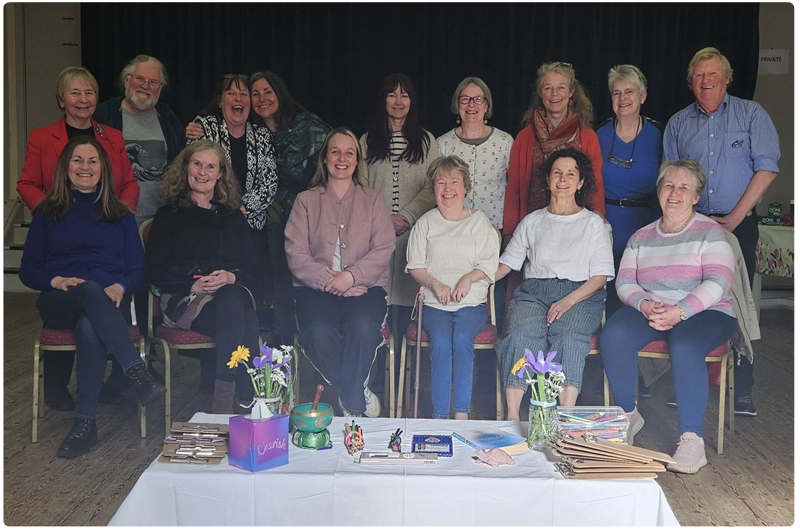
 Who doesn’t love Mary’s moments of inspiration, especially when it doesn’t involve you having to do anything except show up and enjoy! One of Mary’s more recent bright ideas was to hold a movie night featuring Eugene Gendlin's work captured on video, which the International Focusing Institute had complied on their YouTube channel. Many of the clips involved the generosity and tremendous work of Nada Lou. Nada carefully combed through hours of footage of Gene sharing his wisdom with groups, and condensed it down into digestible bites to nourish us all.
Key themes were on how listening, which Gene learned from Carl Rogers, became such an important feature – it didn’t feature in the first stage of Focusing, strange as that might now seem. We heard Gene on Focusing Partnerships, on his concept of ‘carrying forward’ and his emphasis on ‘action steps.'
Nada-remarked at one stage that her husband felt like Gene lived in the house with them as he heard so often, while editing the videos. We were honoured to have Nada as a guest at the Irish Focusing Network Gathering which was a wonderfully light and informative evening for us all. Mary’s careful selection of videos held a really nice Focusing flow through the themes.
Nada carefully combed through hours of footage of Gene sharing his wisdom with groups, and condensed it down into digestible bites to nourish us all. Nada remarked at one stage that her husband felt like Gene lived in the house with them as he heard so often. We were honoured to have Nada as a guest at the Irish Focusing Network Gathering which was a wonderfully light and informative evening for us all. Mary’s careful selection of videos held a really nice Focusing flow through the themes.
Following on from the Irish Focusing Network evening, Mary held a Roundtable on it for TIFI and again it was very well attended and thoroughly enjoyed by all. It was a very engaging experience, with some interesting contributions on Gene’s philosophy and how that influenced the shape
of Focusing as we know it. Nada very graciously answered questions about clips and broadened our
perspective on Gene’s wisdom.
We are grateful to Mary for opening the door to what feels like a beginning of further gatherings like this together. And if you want to do another one Mary, I'll have the videos ready for you without ads!
Here is the link to the section of the TIFI website that hosts many videos featuring Gene talking about a range of topics - Gene Gendlin Videos- Click here. We hope you enjoy exploring more.
Below is a list of the videos we viewed on at the event with a link to the TIFI YouTube channel where they are hosted. We invite you to explore these in your own time and it might be worth hosting your
own ’movie bites’ and sharing the wisdom – and may popcorn with some Focusing friends.
1. Why Focusing works and what it is not
2. On listening, reflecting and on Focusing Partnerships
- What I learned from Rogers - with Eugene Gendlin Ph.D.
- Gene Gendlin and Lynn Preston on Reflecting
- The Pros and Cons of Focusing Partnerships
3. On carrying forward and action steps
4. On Focusing and teaching Focusing
Irish Focusing Network Movie Night - 27th November 2024
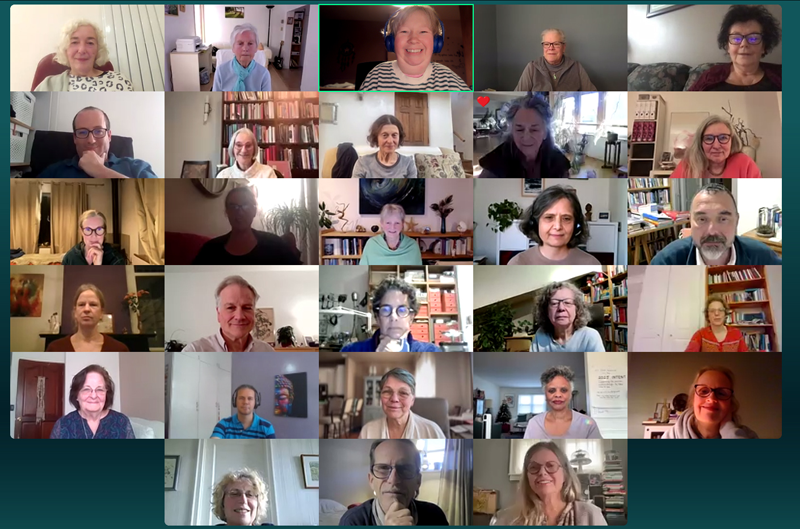
The International Focusing Institute - Roundtable 28th January 2025
Written by Elaine Goggin
Spring is almost here and along with the lengthening days, we look forward to our annual Spring gathering which will take place on 5th April in Elaine’s home village of Ardpatrick Co Limerick. Please save the date. We look forward to seeing many of you there.
Our AGM which took place in January provided an opportunity to reflect on 2024. In April Marta Fabregat kindly hosted a beautiful day in Gort, Co Galway. Our Autumn Gathering took place in the Dominican Centre in Tallaght in September.
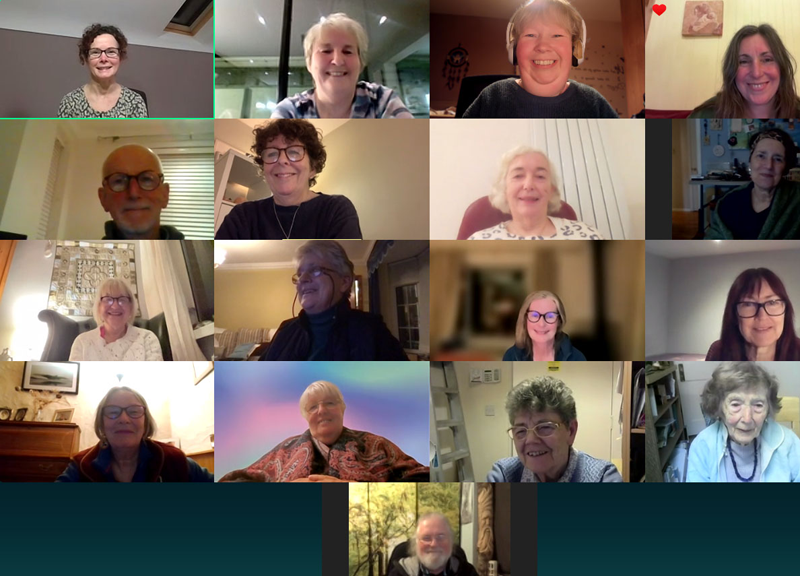
AGM 2025 Screenshot
We also had an active year online. In May, Gordon Adam from the British Focusing Association facilitated an evening with the theme of Focusing in community. In November, Mary Jennings facilitated a Movie Bites evening where we viewed video clips from the TIFI library. We were privileged to have Nada Lou join us for that evening making it a very special occasion for our network.
Much appreciation was expressed at the AGM for the many activities and resources offered by members: the bi-monthly poetry evenings, our weekly zoom sessions, and of course our wonderful newsletters. Many have also enjoyed listening to the Focusing Pathways podcasts.
A desire to encourage and develop good Focusing practice led the committee to organise a series of monthly Listening Skills Refresher evenings which were generously facilitated by our wonderful Focusing teachers. The dates of upcoming evenings are March 31st, April 28th and May 28th. We’ve been delighted and encouraged by the attendance and would love to see them continue. If you’re a Focusing teacher and would like to facilitate a Refresher evening in the future, please get in touch.
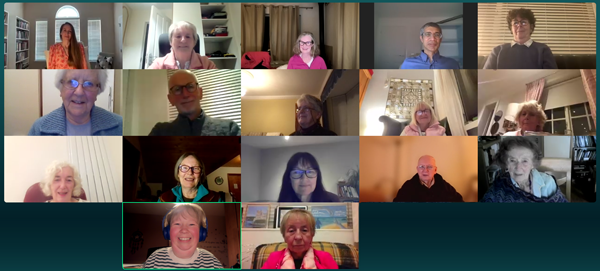
Screenshot from Anne Lawerence's class
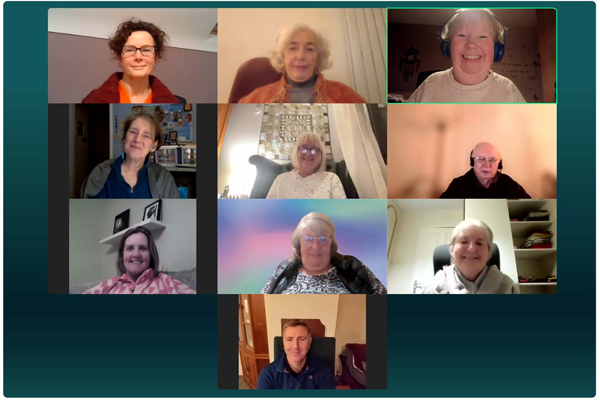
Screenshot from Therese's Ryan's class
Our heart-filled thanks to everyone who supports the network: those who facilitate the workshops for our in person gatherings and our online events including our Refresher evenings, to our zoom hosts who keep the weekly zoom sessions going smoothly, and to those who produce our newsletters, as well as the committee who work behind the scenes.
Suggestions offered during the AGM included: an email address for raising specific concerns which may arise, the possibility of organising a conference or larger workshop to promote Focusing and support the growth of our network, a space for sharing the rich Focusing stories of our members.
The committee is currently drawing up guidance for good Focusing practice in order to nurture and maintain a sense of safety within our community and to promote respectful connection. We will be sharing these guidelines with you all by email in the coming weeks.
It’s the time of year to renew your membership, so if you haven’t already done so, please take the time to register using the link by clicking here.
We are delighted to welcome some Focusing friends from Iceland to our network. Please look out for them at the zoom sessions and make them feel welcome.
Finally, we encourage you to consider how you might contribute to growing and developing our network. It may be helping out with the newsletter, becoming a host for our weekly zoom sessions, offering a workshop online or at one of our in person gatherings, or spreading the word about Focusing. There are lots of opportunities to become involved. We depend on all of you, our members, to keep our network alive and growing and thriving. Thank you for your ongoing support and commitment.
The committee members are:
Chairperson Therese Ryan
Secretary Kay McKinney
Finance Officer Peter Duffy
Elaine Goggin
Marta Fabregat
Interactive Focusing is a form of Focusing that was developed by Janet Klein (d. 2010) with the help of Mary McGuire. IF has been described as a ‘third stage’ of Focusing, beginning with Focusing alone, then Focusing in partnerships and now Interactive Focusing.
Janet developed Interactive Focusing while working on a PhD in Psychology. For her thesis she focussed on Focusing partnerships.
She observed and interviewed Focusers who had long-term, ongoing Focusing partnerships. For their exchange, she asked the partners to Focus with ‘what their partnership and their partner meant to them. She discovered that these Focusers hadn’t ever articulated what this meant to them before. In addition, she realised that Focusing partnerships were, in fact, interactive even though “there was a strict prohibition against touching the material of your partner”.
She describes it this way, “The partnership was set up on the lines of a transaction, two equal but separate pieces. The listener was to clear the space of her own issues in order to make room to listen to the Focuser. When they exchanged roles, the second Focuser wasn’t to touch on the material of the first Focuser. It became apparent to me, however, that there was a subterranean interaction, though it never had a chance to surface due to the prohibition. I wanted to frontally address this unspoken aspect.”
As a result of her findings, she created a structure, Interactive Focusing, (IF) that would allow for interaction while ‘preserving each person’s material and boundaries’. Following this kind of interactive process would allow the partners to safely process their relationship, if they wanted. Barbara Dickinson describes it thus, “A regular practice of IF creates a sort of “space” between two people where they can bring their individual issues as well as issues that affect both people in the relationship.”
There are several stages to a full IF process. The following is but a very brief description. See below for further reading/resources.
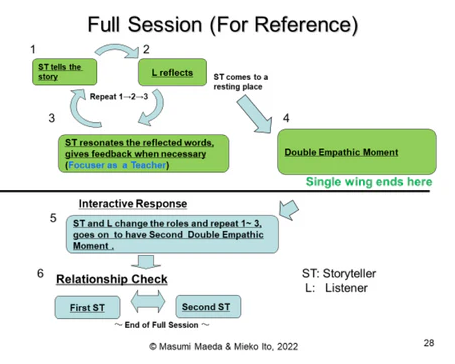
An IF session begins in a similar way to a usual Focusing session; one person Focuses first for the agreed time while the other person listens/reflects. Then, in a departure from most Focuser’s experience, at the end of that part the listener offers an empathic response to the Focuser, usually in the form of a symbol. The Focuser responds to this. This form of Focusing requires that the Focuser say enough during their time so that the listener can actually respond. (In my experience, more and more long-term Focusing partners are bringing this element into their Focusing exchanges.)
Then it is the turn of the second Focuser, who begins by checking inside to see what has touched them from the session so far. They then continue in the usual way to explore their experiencing while the second listener listens/reflects. At the end of that, the second listener offers an empathic response and the Focuser responds.
After the above and to close the session, both partners in turn now have a ‘relationship check’. Each partner addresses the following questions or similar in a Focusing way; “How am I with myself?” and “How am I with my partner?” while their partner listens/reflects.
 As well as helping to deepen the relationship between Focusers, particularly those who know each other well, Interactive Focusing process can be used for dealing safely and effectively with conflicts and for healing troubled areas in relationships.
If you would like to explore this form of Focusing further you can check out the websites below. The book on the method is available from TIFI bookstore and Nada Lou has a video of Janet and Mary Maguire explaining, explicating and demonstrating the process. If you would be interested in an introductory, day-long, in-person workshop to experience this method please contact me at
Further Reading and Resources
https://focusing.org/more/dr-janet-klein
https://www.youtube.com/watch?v=tOfIpVpY1Ek&ab_channel=LynnPrestonFocusingRelationalPsychotherapy
https://focusinginternational.org/resources/interactive-focusing/
https://learnfocusing.org/en-gb/pages/interactive-focusing-resources?_pos=1&_sid=69ae60f9f&_ss=r
https://www.cefocusing.com/wordpress/interpersonal-focusing-kleins-interactive-focusing-protocol/
Campbell Purton – Self Therapy: A Focusing Guide. Athens: Eurasia Publications (2022)
Campbell Purton is an English Focusing teacher. His career somewhat mirrored Eugene Gendlin’s in that he studied philosophy to PH.D. and then trained as a person-centred counsellor and Focusing teacher.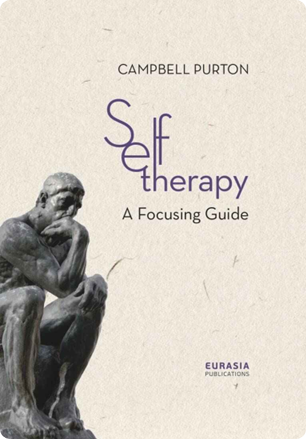
The cover of this relatively short book shows Rodin’s sculpture, ‘Le pénseur/The Thinker’ – an apt image for how, in his introduction, Campell describes Focusing as “giving sustained attention to our trouble in a way that leads to steps of change" (p.15). He also suggests that in the sculpture’s stance of stillness and apparent waiting and attending, Focusing may be likened to a kind of ‘pondering’ (p.109).
While set as it were in the world of psychotherapy it is primarily a book about Focusing and more specifically Focusing alone. At the outset he says that the book is intended as a self-help guide to working with the kinds of difficulties that move people to seek counselling help. From a therapy perspective he sees Focusing having a place alongside psychotherapy in the same way that complementary medicine can have a place alongside traditional medicine and possibly as a way of continuing the process after formal therapy sessions have ended. His first chapter is a broad, wide-ranging review of the psychotherapeutic scene particularly in the UK and of Focusing Oriented Therapy.
In the following three chapters Campbell, adopting the Gendlian approach, explains and explicates the classic six movements of Focusing, along with an exploration of some of the difficulties that can arise and how to work with them. He provides a wealth of examples of Focusing experiences, some of them quite detailed. He points particularly to the role of metaphor in the process and draws on the analogies and metaphors of Lu Ji a third century, Japanese lyric poet.
There are some aspects of Focusing that he repeatedly emphasises throughout the book; the usefulness and effectiveness of Focusing in everyday life; deliberately not attending to the familiar details of a problem or difficulty when beginning a Focusing session; “… keeping of our attention on the problem as a whole, while allowing new details to emerge” (p.37); “attending, not so much to what is already there, but to what is on its way, or what could come if we give it a chance” (p.38).
Chapters dealing briefly with Trauma and with Moods and Medication are interesting and informative. In regard to the former particularly, while he commends the use of Focusing he urges caution about going it completely alone. There follows an important chapter on Action Steps, an often glossed-over or neglected aspect of Focusing. Finally, there is the chapter called ‘How does it work?’ which he says is for those people who are curious about what is involved in the process of Focusing and which looks at some of its more philosophical aspects.
Though he writes in a deliberate, methodical way, as becomes a philosopher, the book is very accessible. It is probably most suitable for counsellors/psychotherapists and people who have already begun their Focusing journey or/and those who have some familiarity with the process. Experienced Focusers would benefit from his distinct perspective on Focusing. I think this is a welcome and helpful addition to the growing library of books on Focusing.
Campbell has written a number of books on therapy and Focusing and many articles on Focusing, Buddhism and Philosophy (see his website for a list and access - http://www.dwelling.me.uk/focusing.htm)
Written by Tom Larkin
Focusing is a relatively new concept in the world of coaching, yet there are many commonalities between the two which makes their crossing exciting and full of possibility. Both Focusing Oriented Therapy and Coaching are forward moving ways of working, in which the core belief is that the client has their own answers and the coach/listener uses the skills of deep listening, to support naturally occurring change and forward moving energy.
MEASURING THE EFFECTIVENESS OF FOCUSING-ORIENTED COACHING
To evidence the effectiveness of Focusing-Oriented coaching, Báirbre Meehan undertook a self-funded five-year research project. Working with GPs, psychotherapists and word of mouth referrals, Báirbre supported and monitored Mental Well Being improvements in over 100 people across one-thousand one-on-one coaching hours.
The objective of the project was to measure the impact of a short-term Focusing-Oriented Coaching approach on the Mental Well Being (MWB) of participants, individually and collectively. In doing so, the research served to establish how best to cultivate practices of awareness and understand which tools and strategies best support individuals to assess, manage and maintain their own MWB.
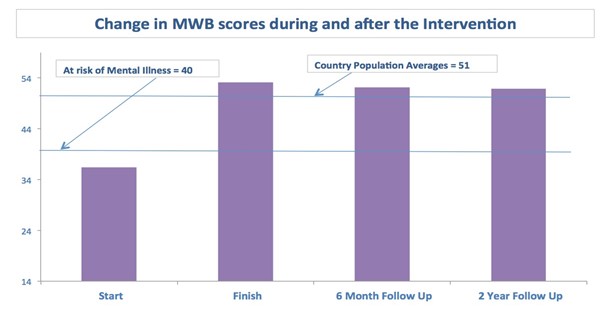
Using a quantitative MWB measurement tool, the Mental Well Being of each participant was assessed at the start, end and six months after the intervention, enabling us to measure the individual and collective MWB change over time.
Results of the 8-hour coaching intervention showed a 70% improvement in collective MWB at the end of the intervention, with the improvement being maintained both six months and two years after the intervention period. The following graph shows the results.
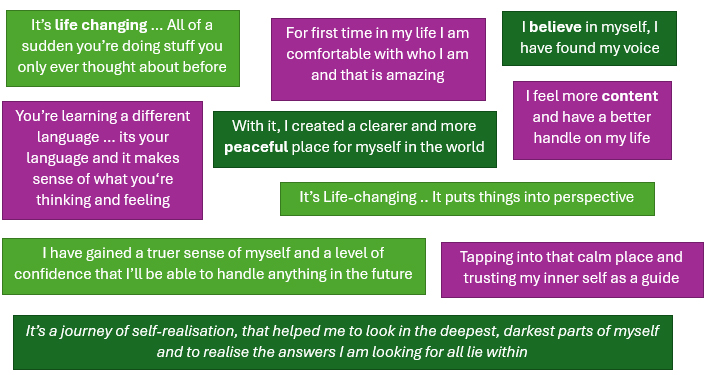
As significant as the above measurements were, the testimonials from participants were even more important. A sample are shown here. For more testimonials from research participants and from referring professional, visit Báirbre’s website https://www.pause.ie/research/
Báirbre’s coaching journey began 12 years ago, at a time when her personal-development journey led her to Focusing. Her coaching practice is informed by 25 years in people management in roles such as CEO, organisational/leadership development and finance director … and many more years in the roles of daughter, mother, wife, sister, friend, coach etc..
Focusing-Oriented Coaching is Báirbre’s passion and she is devoted to developing and sharing it. Báirbre teaches Focusing-Oriented Coaching programs to coaches and is a coach supervisor.
If you are a coach and interested in learning how to integrate Focusing into your practice or if you are looking for a coach who works in a Focusing way, contact Báirbre at
A Retreat on The Joy of Samhain. Offered by: Deirdre Ní Chinneide, Fr Philip Baxter and John Keane at Ards Friary, November 2024.
A celebration of music, nature and the body as it is sensed from the inside.
Written by: John Keane.
This weekend retreat explored the Celtic Celebration of Samhain using the themes of Darkness and Light to appreciate the changing nature of reality. 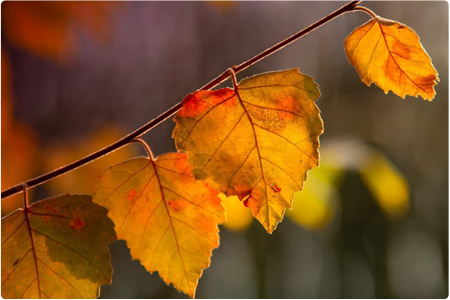
During the weekend we explored the nature of this change and ways of resourcing ourselves to meet it and grow with it.
We explored how our usual thought processes can be an obstacle to this journey, preventing us from appreciating our intimate connection to reality and nature.
Celtic spirituality, music, nature, our own bodies (and their innate sense of Love and Affection) offer doorways into living freshly into the changes and challenges of life.
In Celtic Ireland over 2,000 years ago, Samhain was the division of the year between the lighter half (summer) and the darker half (winter). At Samhain, the division between this world and the otherworld was at its thinnest.
Food was prepared for the living and the dead. Food for the ancestors who were in no position to eat it, was ritually shared with the less well off.
Christianity incorporated the honouring of the dead into the Christian calendar with All Saints (All Hallows) on November 1st, followed by All Souls on November 2nd.
During our time together, we were guided through the woodlands of Ards by an expert woodsman who assisted us in appreciating the natural environment. This allowed us to sense into the rhythm of nature as it utilises the opportunity of winter/darkness to prepare itself for the coming of summer/light.
We had a celebration on the beach in Ards – connecting to the water and its natural ebb and flow. Sensing our connection into that dimension of the natural environment.
The theme of light was emphasised in the lighting of the fire in the living room in Ards, where we shared stories, and came together to share food and wine.
An exploration of the Celtic calendar assisted us in appreciating the difference between linear time – and a sense of time that is sensitive to the ongoing rhythm to nature.
All of this was interspersed with BioSpiritual Focusing exercises and the beautiful music and poetry offered by Deirdre.
We also took the opportunity to remember those who have passed before us, and how they are especially present to us at this “threshold” time of year.
As we move forward, we are working to incorporate the main Celtic festivals into the retreats we will offer in Ards Friary. The links between Franciscan Spirituality, BioSpiritual Focusing and Celtic Spirituality and music offer a fertile foundation to people seeking to embody the interconnectedness of all living processes. This will allow participants to find their own place in this ongoing process.
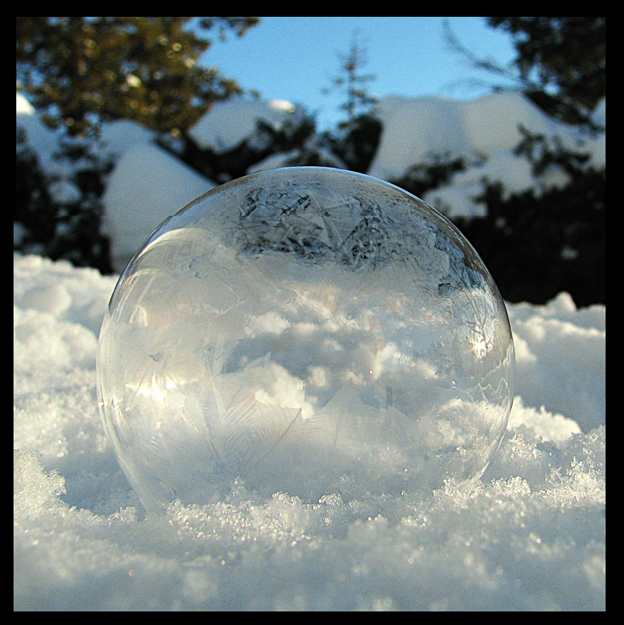
All conditions must be right to create this temporary “art installation” and we might wonder what is the motivation behind it?
It might be just to witness how this thinnest of membranes develops into a thin sphere of ice which shelters what is inside from the outside elements. It might break at any instant, letting out the warm air that is trapped inside, but for now, it is completely and wonderfully whole.
It reminds us of the thin “outer” layer we gently break open when we reach towards the felt sense that lies within. The breaking open of this “membrane of protection”, allows us to visit and welcome all that is present inside and to bring it to our Focusing practice.
As we reflect on this photo, we might just bring our attention to the fact that this ice bubble would not exist without our warm breath to form it.
- Is there something in me that is waiting for my warm breath to give it expression and form?Ice bubble: oil, soap and water solution + sub-zero weather + warm breath.
Denise Durocher, January 2025
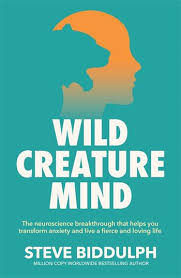
BOOK REVIEW: Wild Creature Mind by Steve Biddulph Publisher: Bluebird; Main Market edition (12 Sept. 2024)
Weaving together Ian McGilchrist’s take on neuroscience and Focusing, I found this to be an excellent book and one I have recommended over and over again.
The author has a deep appreciating for focusing and explicates it well, perhaps especially for newcomers. Here’s an excerpt: “Tell it both ‘welcome’ and ‘thank you’. Soften around it to give it room. Try out a word or two to describe it. This word or two will never be quite right on first go. Try a better word, and listen to see if your felt sense says, ‘Yes.’ And then, in the way that we sometimes have to just abandon control in order for anything magical to happen – to dance, to make love with abandon, to laugh, to play great music – you just let what comes come.“
Written by Clare Myatt
Rediscovering the Lost Body Connection within Christianity Spirituality (2010)
Edwin M. Mc Mahon and Peter A. Campbell
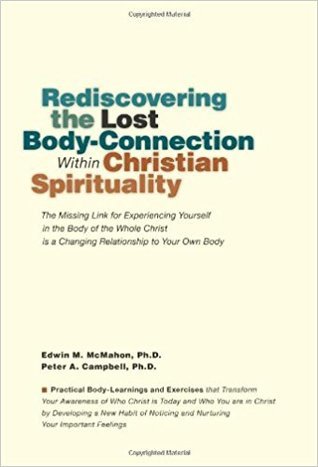 It has been many years since I read a book on Bio-Spirituality by Ed and Pete. The above named book was completely new to me. I was captured from the first meeting as well as the recommended chapters to read before each session. It was a diverse group from many countries and I learned a lot from our reflections, questions, feedback and sharing in the break-out rooms. Aine opened the sessions with a range of guided settling and grounding experiences. The pace of the sessions was gentle and slow which tied in with one of the overarching themes of this book study.
The key areas we looked at were the practice of noticing and nurturing using the focusing process as described by Gendlin. We were invited to do a timeline of our lives exploring the lived experiences of feeling comfort and connection, termed as an “affectionate friend”. This was done most sensitively acknowledging that traumatic or negative experiences may have been part of our life stories. I enjoyed doing my timeline as it reminded me of the many experiences of people and special places that were my “affectionate teachers” and that I can continue to draw from now. From here on I shall use the term affectionate friend as this describes how the whole experience evolved for me. The process helped me to access some new affectionate friend experiences as well. We talked about times when we did not have an affectionate friend when we may have needed it, exploring ways we can bring our discovered affectionate friends experiences to all of that now. This reminds me of a comment by Dr Gabor Mate “No matter what happened in the past you can heal it in the now….. With a practice in developing self compassion and as well as reaching out for help, as this is how we are made, hardwired, for connection”. It is in relationships we are damaged and it is in relationships we are healed, a very human paradox.
We explored symbols and metaphors and the bodily mutual interactions with the felt sense. As a lover of poetry I had a profound experience at our in-person gathering in Dublin 2024. The description in this book described exactly my actual experience of focusing with a poem. The poem “functioned as a metaphorical bridge that interacted with a deeper felt sense, opening a door and carrying me across some visceral threshold into a different place and a transformed feeling within my own body. The words of the poem, as an explanation and information, in no way could account for the sheer visceral power of this interacting relationship between the poem as metaphor and my own body’s unique felt sensing. Gendlin suggests that there exists a deeper felt meaning, a felt sense within the body which can be accessed and encouraged to unfold further when interaction with an appropriate symbol or metaphor…allowing a further felt-revelation and visceral change to emerge from within” (Chapter 4) “Journeying into Your Own Inner World of Felt-Sensing” Pg 34. The something fresh and new that emerged for me was related to being with a loved one at the time of death. More was revealed about a connection to something beyond the whole experience. It felt like pure gift and grace in the now, just as described so eloquently in this book.
Three interesting further themes that resonated with me were process skipping, the philosophy of addiction in relation to church and faith, including the exploration of “Love your enemies” (Chapter 16) we explored this piece of scripture in relation to coping with physical and emotional pain. Bringing this approach to pain and illness has brought a tangible ease and relief to how I cope with this most natural human difficulty.
We were invited to watch out for times when we used distraction, numbing, avoidance (busyness) and substituting (food, alcohol, work, social media) as a possible way of process skipping. This helps me to pause and take some time to sense into how I am feeling or to use a focusing question from the book “What needs my loving caring presence just now?”
I was completely fascinated with the chapter on addiction and church/faith. This has expanded and deepened my understanding regarding current issues within church and connected me to my own living faith in a new and fresh way, feeling again like gift and grace.
To conclude, “Nothing changes and everything changes” has been my experience. These are also the words of a beautiful poem “Inviting Spaciousness” by Rosemerry Wahtola Trommer. The words capture for me a very deep connection into the wider field of focusing philosophy. I invite you to go onto the Poetry section of IFN website and listen to the recent recording.
I will be reading this book for years to come as I feel I have just began something fresh and new.
Thank you to John and Aine.
Marie Mc Guigan
by Mary Jennings
Gendlin lists four types of listening in his book Focusing:
1. Helping another person focus while talking
2. Using your own feelings and reactions about the other person
3. Interaction (in everyday situations)
4. Interacting in a group
Here, I will touch on the first two types as they might relate to Focusing Partnerships.
The first type, helping another person focus while talking, has evolved into the kind of ‘reflective listening’ we do in Focusing Partnerships. These partnerships have their own protocols such as, when you are the listener, being careful not to offer advice, not to comment on the Focuser’s process and not to put anything of your own experience into it. Focusers generally take care to abide by these valued practices.
Where might the second type of listening Gendlin outlines - Using your own feelings and reactions about the other person fit, if at all, within Focusing Partnerships? Let me make some suggestions.
I was introduced to what Tom Larkin calls The Empathic Moment in Focusing Partnership at a workshop last year. He was influenced both by this own long-term Focusing partners and by the work of Janet Klein on Interactive Focusing in presenting this practice. It was Janet’s discovery that listeners are touched by what the focuser says; it is part of the whole process/interaction, she suggests.
The Empathic Moment is an invitation to the listener to pause, to allow a sense of how the Focuser’s process has touched the listener. The listener then expresses their sense of how ‘all that’ has been for the Focuser and offers this as an ‘empathic moment’. That might come as a phrase, an image or a metaphor. It is, in some sense, it seems to me, an enhanced form of reflection. The Focuser checks if what the listener say about their process fits and, as ever, the Focuser is in charge and may respond in a way that is right for them.
Very often, as this is done with empathy, it deepens the Focuser’s own experience as well as deepening the connection between listener and focuser. It is important to say offering this ‘empathic moment’ can be part of a Focusing Partnership only where there is agreement – in advance – that this will be included as part of the process. It seems to fit with what Gendlin is referring to in this second type of listening of using our own feelings and reactions about what we have heard. It also fits with his wider concept of ‘interaction first’ which he outlines in A Process Model.
This idea of using The Empathic Moment may be of value to you – or not – in a Focusing Partnership situation. Initially, when I first tried offering this practice, I experienced some unease by seemingly ‘breaking the rules’ of what is considered good practice in partnerships.
You will see in the video clip that the initial interaction is based on the tried and tested Focusing Partnership model, with accurate reflection and checking if any word I used that was different to what the Focuser said, fitted. It might have ended when the ‘felt shift’ came for the Focuser and that would be fine. The Empathic Moment follows on from that and is done only when the listener has checked if the Focuser’s process feels complete for now.
See what the sense of The Empathic Moment is for you and if this is something you might consider in your Focusing Partnerships. You might like to try it with curiosity and care.
by Denise Durocher
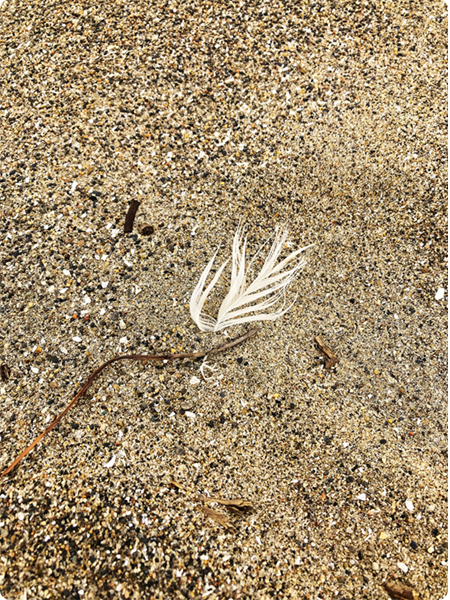
Photo: Denise Durocher, Seacliff Beach, Leamington Ontario
Walking on a large beach on Lake Erie (Ontario) I was purposefully searching for very small objects.
I was attracted to this little feather being whipped around in the gusty wind. It’s littleness in the bigness of the beach made me stop for a moment to admire it and to take a few photos.
What I thought was how this very small feather was once part of a bigger entity, the seagull, and played a part in the bird’s life. It helped it to fly, it contributed to its buoyancy when it rested on the water, it helped it keep warm and dry.
In Focusing, I have often found that exploring the smallest voice, feeling or thought, often shows me how they are part of the big picture. They have contributed to my well-being especially in difficult times. Lately, in a Focusing session, the small voice inside had two words to offer:
“For now”.
BOOK REVIEW by Tom Larkin
My Focusing Journal - Nina Trebec
Sometimes after a Focusing exchange, when I want to make a note about what I have learned/ experienced, I have to scramble around looking for something to write on. More often than not, I have used the backs of envelopes or my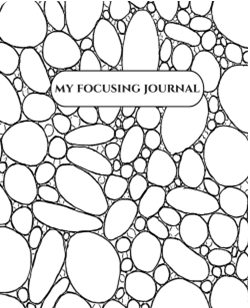 phone to record whatever it was that I wanted to remember or that seemed significant. I didn’t know it then, but this little booklet was what was missing at those times. Nina Trebec has done the Focusing world a great service by providing a comprehensive framework for a systematic reflection on formal (or informal, ‘on-the-go’) Focusing experiences.
The booklet contains 50 guided reflections with eight prompts/questions/suggestions spread over two pages. In these pages one can describe one’s felt sense, different ‘somethings’ or parts that emerged, the dynamic between Focuser and companion, insights gained, next steps and more. There is also a (relatively small) space to express one’s Focusing experience through doodles/drawing/art. Nina suggests that writing about our Focusing sessions can help Focusers with reflection and integration after a session, getting to know oneself better and honouring and loving all one’s parts, by writing about them.
I imagine that this journal would be particularly helpful for people in the early stages of their Focusing journey (say the first ten years or so!). From my experience of trying it out for this review I can say it is also useful for more experienced practitioners. There are a lot of other guided reflective journals out there for planning, meditation etc. – I think it’s great to have one dedicated specifically to Focusing.
Currently the journal seems to be only available from amazon.co.uk.
BOOK REVIEW by Tom Larkin
Peter Gill – The Way of Curiosity: Discovering wisdom through listening to the body. Published by Living Focusing Press, May 2024.
Peter Gill is a Focusing teacher and coordinator living and working in the UK. He is also a Somatic Experiencing practitioner and has trained in Nature-Connection and leading Grief Circles.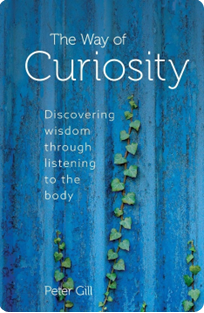
This little book with a big heart is a very readable introduction to Focusing. While aimed at those who know little or nothing about Focusing, it has a lot to offer the experienced Focuser.
In addition to being a contemplation on Focusing and its processes, written in a very accessible way, it is very practical, containing 17 guided focusing invitations following on from an exploration on a particular topic related to Focusing or life issues e.g. parenting, loss, trauma, death etc. It is divided into two parts; part 1; “the doorway and the guide”, being an introduction and a practical guide and part two; “through the door”, a collection of Peter’s reflections on Focusing experiences - a genuine treasure trove of distilled wisdom. He judiciously quotes Eugene Gendlin, the developer of Focusing and refers a lot to Ann Weiser Cornell’s approach to the Focusing process (Inner Relationship Focusing). He also draws on a Buddhist understanding of life issues and situations.
Curiosity is at the heart of his elucidation of the Focusing process. Again and again, he invites and encourages the reader to pause and be curious about what’s going on in themselves and their lives when they are stuck, angry, hurt unsure etc. He says, “The key is not to take something at face value but to get curious as to what’s happening beneath the stories”
While overall, I really enjoyed, not so much reading as savouring this little book, what stands out for me is the way he employs similes, metaphors, personal instances and anecdotes that ground/concretise the Focusing experience, opening up fresh ways of seeing and understanding this life-enhancing practice – a real delight.
Peter’s website, https://www.livingfocusing.co.uk/ is a veritable mine of Focusing articles, audio recordings and upcoming events.
He also has a Youtube channel: https://www.youtube.com/@livingfocusing