



Netflix, Self-Acceptance and Focusing: A Surprising Connection
Focusing advocates for a radical notion: only when we accept every part of ourselves does change really happen. But how does this idea hold up against the self-improvement messages that bombard us? I was delighted to discover a powerful example of how it can in the least likely place ever - a TV series on Netflix.
I’d love to share the excerpt here with you, after giving you some context.
It comes from a Swedish drama called Love and Anarchy. I've kept the plot summary incomplete but there is a small spoiler from Ep 1 of Series 2..
The series follows Sofie, who is a high-powered business consultant. She has the perfect life - stunning home, cultured husband, fashionable career, and loving daughters.
She also has a zany side, however, which comes to life when a younger colleague challenges her to a set of dares. She dresses as Cindy Lauper, starts walking backwards, and dribbles coffee down her face in an important meeting.
Bizarre behaviour which her status-conscious husband deplores (he fears she is becoming too much like her troubled father, who is a regular visitor to the psych ward), but we notice Sofie coming alive. She seems more vital.
Her father, Lars, commits suicide, and Sofie begins to unravel. She keeps seeing his ghost and getting into arguments with him, and this freaks her out. She starts making poor work decisions, sleeping around and even ends up in the psych ward herself (goaded on by her dead father's voice).
It is in the psych ward that the following exchange takes place between Sofie and her father’s ghost, and this is the part that I loved:
Sofie: Papa, we can’t go on like this.
Lars: It’s just I'm so scared you'll make the same mistakes that I did. I never learned to like myself.
Sofie: I've always thought that if I was genuine, if I was myself, I'll end up like you.
Lars: Oh no! On the contrary, if you don't accept yourself, you'll end up like me.
I think that Sofie fears that if she accepts her ‘mad’ parts, she is on the road to ruination. But, as her father points out, it was his inability to accept his ‘mad’ parts that led to his ruination.
As I said, this idea that in order to lead desirable lives, we must change or eradicate our ‘undesirable’ parts is deeply rooted in our culture. There are books and books telling us how to be our best selves - how to lose weight, to get promoted, to have more willpower, to feel more confident. The assumption seems to be that it is only once you have changed your ‘bad’ parts, that you can be your most fabulous self.
But the Focusing approach is different. The Focusing approach is to first listen to these parts and give them space. We are interested in them just as they are. We do not seek to change them, no matter how socially unacceptable they may seem. We listen to them, give them our company, and our empathy. And in this space, they have room to become what they need to be.
Sofie wasn’t ‘mad’ in any way. She simply had parts that recognised that she wasn’t being herself in her ‘perfect’ life. And she had a part that believed that if she was her genuine self - instead of this apparently ideal self - she would become ostracised like her Dad had been.
But once she recognises this, and allows her parts to be themselves, her life and relationships move forward in powerful ways.
What parts of yourself feel 'unacceptable' to show in your daily life? Could those parts carry a wisdom you haven't yet explored?
I loved seeing this example on Netflix, as the more we are reminded of the power of self-acceptance, the easier it will be to adopt it as a route to change.
by Fiona O'Meara
Creative Corner: Corn Husk Doll
Corn Husk Doll: The Story
“She was instructed to play with all the children and keep them entertained. She traveled to many villages and the children loved her.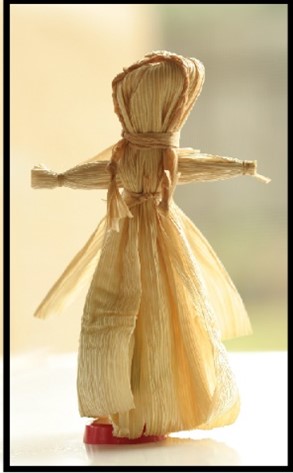
Many people would comment on her beauty. Soon the doll forgot about her duties and spent long hours by the water, admiring her reflection.
Her face was removed to remind the people to remain humble and not to become obsessed with appearance, as true beauty is found in fulfilling your commitments.
To this day, the cornhusk doll remains faceless.”’
Haudenosaunee Doll-Maker, Betts Doxtator
Creating our own Haudenosaunee Corn Husk Dolls
In October, Rennie Buenting came to Canada to spend time traveling in the Rocky Mountains for a while, and then to my home in Ottawa, for a wonderful visit. We were so lucky to be together in time for the Indigenous Harvest Festival (Tagwagi) at the nearby Madahoki Farm.
We registered for a Corn Husk Doll making workshop (great story-telling and lots of creative fun), ate Indian Tacos and corn soup, listened to a Haudenosaunee singer accompanied by a very young dancer in his regalia, enjoyed the story of the Three Sisters, Corn, Bean and Squash, admired Spirit Horses, and enjoyed several hours of rich encounters and beautiful surroundings. Here are some photos of our Corn Husk Dolls as we were creating them.
We had more adventures of course, and the time went by so quickly. How fortunate it was to reconnect in person with Rennie, as she was present at my first workshop on Focusing, led by Marian Burke and Tom Larkin, at the Emmaus Centre near Dublin, a few years ago.
I am so grateful to the Irish Focusing Network who made the very happy decision to enable ZOOM practice sessions when the pandemic hit. Belonging to this group, reconnecting with Rennie, Tom and Marian, and becoming friends with so many of you, has had such a positive impact on my life in the last years. MERCI BEAUCOUP MES AMIS ET AMIES!!!
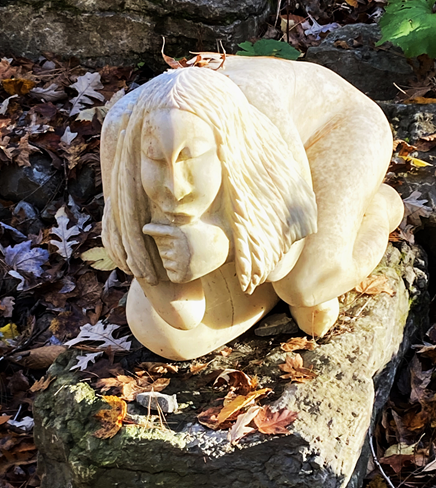
Corn Husk Doll Sculpture
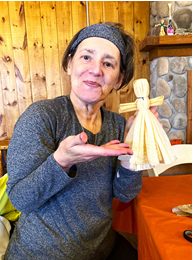
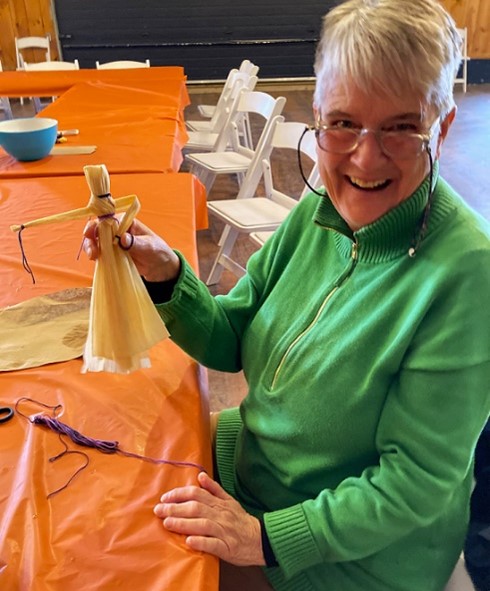
Denise and Rennie with their Corn Husk Dolls
IFN Committe Update April 2024
Welcoming our new chairperson Therese Ryan
I’m honoured to be the new chairperson of the Irish Focusing Network succeeding Margaret Quinn who has stepped down after three years as the first chairperson of our network.
At the beginning of 2020 the word “zoom” was just a simple verb. Little did we realise how we would come to use “Zoom” to describe an online platform through which we would connect with people all over the world. In Spring of 2020 at the beginning of Covid, Margaret along with Mary Jennings emailed Focusers in Ireland with the idea of coming together online. Before long, weekly Focusing sessions began on Zoom and in 2022 The Irish Focusing Network was born.
Margaret brought tremendous energy and expertise to the role of chairperson and helped build a solid organisation dedicated to nurturing Focusing and connecting Focusers. Her unwavering commitment and vision ensured the growth and development of our network into the wonderful welcoming community it is today. We’re delighted that Margaret will continue to be involved in carrying forward new IFN initiatives.
Jayne Goulding has also stepped down from our committee. Jayne, like Margaret, has been a long-term member of the Focusing community in Ireland and a stalwart committee member since the network’s formation. Along with Kay McKinney and Maggie Neary, Jayne led a practice Focusing group for new members. We’re very grateful for her loyalty and dedication.
I’m delighted to welcome our new committee members, Marta Fabregat and Marta Wanczyk. Together with Caroline Moore, Elaine Goggin and Kay McKinney, I look forward to a fruitful year working together to grow and develop our community.
Our Spring gathering on 20th April will be a welcome opportunity to connect and Focus in person. We’re delighted and grateful to Marta Fabregat for hosting this event at An Tionol in Gort, Co. Galway. Our Autumn gathering will take place in Dublin on September 28th .
We’re excited to launch a monthly programme for enhancing Focusing skills, and we also look forward to an online evening in May with Gordon Adam from the British Focusing Association. Our bi-monthly poetry sessions hosted by Marie McGuigan and Elaine Goggin continue and all are welcome to join. And of course our weekly online Focusing sessions continue thanks to our generous hosts. If you have a workshop you’d like to offer either in one of our in person gatherings or online, please get in touch. We’d love to hear from you.
Therese Ryan
Chairperson
Introducing the New Committee Members:
Marta Wanczyk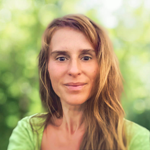
Marta Woo, Polish by origin, Irish by fate, Focusing Practitioner by calling. Over the past decade, she has immersed herself deep into the Focusing practice, with the last four years under mentors Marta Fabregat and Beatrice Blake. Blending her passions, Marta integrates Focusing with diverse modalities like art, creativity, body and sound therapy, and nature-based approaches in her evolving practice: Embody. As she progresses through teacher training and facilitates one-on-one sessions, Marta dedicates herself to fostering communities around Focusing practice.
 Focusing came into my life around 2010-2011 on a Nonviolent Communication retreat. But really it was already happening in an organic way in my life. When I arrived in Ireland in 1999 as a young woman searching for ways of living that promoted peace and creativity. I had been a human rights activist all the previous years since I was a teenager, and probably even since I was born. My family, specially my grandparents were the onces that had a great impact on my search for peace. They taught me about the dangers of judgement and right and wrong ideas and beliefs. So in a way Focusing was who I was, as a mother and a human being trying to find the place in me to hear beyond the ideas and to pause in my body with what was alive, through Zen contemplative practices and mindfulness at the time. Later when I met Eugene´s Gendlin phylosophy it felt like a big sigh in my life, and still continues to be a sigh that is growing and informing me how this peace can be experienced, a green breath.
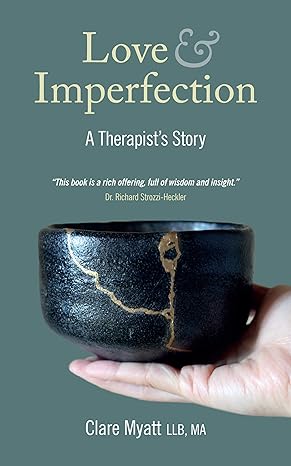
Book Review: Love & Imperfection
Clare Myatt, “Love & Imperfection: a Therapist's Story” Published by Coaching international with Lumphanen Press, 2019.
Clare Myatt is a Focusing practitioner, Somatic Coach and Psychotherapist now living and working in England. This book is her memoir, charting her own journey and that of one of her client’s toward personal growth and healing. Most practitioners would agree that the client - therapist relationship is one of the key factors, if not the most important one, in successful therapy. There are many words used to describe this vital relationship but probably the word least likely to be used in this context is ‘love’. Yet, from the get-go, this is precisely the word Clare uses to describe the relationship between herself and the client (whose name is Bill), love in the sense of agape. Agape is the Greek for “selfless love of one person for another without sexual implications”.
 From this bold beginning, Clare’s and Bill’s individual stories and joint story unfolds. In the early chapters, she describes of her addiction to alcohol in brutally and unsettlingly honest terms, as are her descriptions of her experiences of relationships with men. Equally, the steps she took towards her own recovery are moving and inspirational. The following chapters are concerned with the therapeutic relationship she co-created with Bill. Bill was an ex-U.S. Army soldier, traumatised by his experiences in Vietnam. Beforehand his young life was adversely affected by a remote neglectful upbringing, one of the consequences of which was a deeply-felt shame. He self-soothed (process skipped) his experiences and feelings, conscious and unconscious, with alcohol. The touching story of his slow recovery is revealed in an intimate, fly-on-the-wall account of the therapy process he undertakes with Clare. Having established rapport and trust with Bill, an essential tool she conveys to him is grounding and centring. Thereafter, with mixed success, she employs a variety of relevant approaches but principally the Strozzi Bodywork approach. This involves addressing deeply held muscular contractions maintained in the body using touch, breath, and directed attention. Her thoughts and feelings about Bill and the ebb and flow of his therapeutic journey offer a rare insight into how a therapist navigates the possible interventions at her disposal within the ongoing, fluid, uncertain context of the client’s needs, values, beliefs and behaviour.
Although, not often acknowledged, perhaps all therapists are wounded healers and it is not uncommon for the healing relationship of therapy to work both ways as it did in Bill and Clare’s case. This makes complete sense from a Focusing perspective as we are all each other’s environments and we are in interactions, interaffecting each other all the time.
There is one other leitmotif in the book, a dimension of the therapeutic experience where many therapists fear to tread; spirituality. As therapist do, Clare describes establishing a ‘safe, holding container’ in her consulting room. Several times throughout the book she references a ‘spirit’ or ‘higher power’ present in the space between herself and her clients implying a greater (transcendent) container. She writes about “words coming out of my mouth that aren’t mine, as if I’m channelling some wisdom that I don’t own”.
This is certainly a thought- and feeling-provoking book, showing the care and consideration that Clare as a therapist gives to her clients. Clare’s writing is easy to read and many passages offer lyrical descriptions of her experiences. This is not particularly a ‘Focusing book’, however in one of the later chapters, Clare extolls the virtues of Focusing and draws on Gendlin to arrive at an understanding of “Who I am and therefore what I embody” is what matter in her approach to psychotherapy. Further for Clare, what makes the difference in her approach to therapy is “Getting out of the way of our natural tendency to heal – providing a nurturing, safe space, sometimes a guiding hand – that’s what best facilitates evolution”.
This book will probably be of great interest to therapists from all approaches and also to current and potential clients, however it is at its core, a human story of courage to change an unsatisfactory situation, of how love (agape) can be embodied and of determination to create a meaning life.
“Love & Imperfection: a Therapist's Story” by Clare Myatt is available through online booksellers or by ordering it from your local bookshop for £12.99.
by Tom Larkin