



Worlds of Focusing - Inner Relationship Focusing
Exploring Inner Relationship Focusing
 There is a great diversity of approaches within the worlds of Focusing, but most would agree with Gendlin’s description “Focusing is this very deliberate thing where an ‘I’ is attending to an ‘it’” (Gendlin, 1990, p222). This definition is very apt in Inner Relationship Focusing (IRF) in which the concept of disidentifying from partial selves is key.
IRF was created by Ann Weiser Cornell and Barbara McGavin in the early 1990s. It was born out of both women noticing that some of Gendlin’s suggestions were not facilitative for certain people, and they wanted to find ways to reach those people. Gendlin approved of their work.
In my view, there are some elements that distinguish it from Gendlin’s six steps approach. These are Self-in-Presence, Presence Langage, and Not Clearing a Space.
Self in Presence: When inviting ourselves to get a feel for a whole situation, it is very easy to feel overwhelmed by the emotions that may come in response. Ann and Barbara wished to help people find ways to stay calm and centered no matter what came. They coined the term Self in Presence to “name the state of awareness where a person is able to be present with all kinds of emotional and reactive experiences without being caught up in them.” (Weiser Cornell, 2013, pxxxiii).
By helping you cultivate Self-in-Presence, ‘you’ begin to relate to an ‘it’. You could say it's the difference between being a failure and having a part that feels like a failure. Resourcing, relating and recognising are three ways to help cultivate Self-in-Presence.
Presence Language: Training to be an Inner Relationship Focusing practitioner requires being very attentive to language. Phrases such as “I’m sensing something in me feeling…” are key to Inner Relationship Focusing as they help people to stay in touch with what is here, but from the bigger “I” that is being with the “it”.
As part of this emphasis on language, Ann greatly encourages professionals to avoid using questions. Questions narrow down choice for clients and engage the thinking brain. Consider the difference between these three examples:
1.Question: What does that tightness want you to know?
2.Empathic suggestion: You might sense that tightness and sense what it wants you to know.
3.Empathic suggestion: You might sense that tightness and sense how it feels from its point of view.
Can you feel the difference between these sentences? If a Focuser is asked the first question, their brain may start thinking in ways which might bypass sensing into the direct experience of the tightness. The second suggestion avoids that and is more open and facilitative. The third suggestion goes even more into the experience of the tightness, so that the bigger ‘you’ can be truly empathetic to ‘it’.
Inner Relationship Focusing offers many linguistically precise suggestions for Focusers suitable for specific stages of their process. A precise prompt offered in the right way, at the right time, can be hugely helpful to create that sense of the bigger “I” that can be with the “it”.
Not Clearing a Space:
Unlike the traditional Focusing approach, IRF doesn't insist on meticulously "clearing a space" to address each internal obstacle before delving into the main issue. This allows for quicker access to the core focus. If needed, IRF suggests a quicker version which people can use (acknowledging and saying ‘hello’ to each part).
Why choose Inner Relationship Focusing?
I’ve found Inner Relationship Focusing immensely helpful due to the ways in which it offers precise prompts to help your process move forward when stuck. It is also designed to help newbies experience Focusing in just one session. It is incredibly gentle, and yet can help you dig very deep also.
by Fiona O'Meara
My Experience of Reading Freshly
by Elaine Goggin
As someone who has re-read the, now iconic, book ‘Focusing’ by Eugene Gendlin many times as I prepare for my classes you might ask why I would like to attend this monthly reading group, led by the wonderful Mary Jennings and team. But there is something about that word ‘Freshly’ that really appeals to me. It implies reading it as if you are reading it for the first time, like all cobwebs and assumptions have been cleared out to allow for a new openness to what else might come and deepen your understanding of Focusing.
There is also something stimulating about it being slowly read to you, it’s like you can hear the words differently. In this Focusing environment it feels like you have time and space to truly take in the words and sense in that particular moment how they land and interact with your inner environment. There is something very nourishing about being in that moment with that particular phrase or word. It allows you the space to pause and reflect. So rather than ‘knowing’ what it means in terms of the whole book and Focusing, you can take the word/phrase explore what it means in that instance.
Being online with people from all over the world is very special, I have attended all 3 offerings so far and each month I have met different people in the breakout rooms where we have the opportunity to discuss what has touched us or you can discuss something that you had a curiosity about. Each time I have had different experiences but each equally as wonderful.
The best way I can describe this experience is what it is like Focusing on your own or Focusing with a partner. Yes, you can do Focusing on your own but having the presence of someone else to listen and hold space with you can be far more transformative. This for me is similar, of course you can read the book on your own and get so much from it but reading it together with the diversity that the International Focusing Institute offers it provides something more. After the breakout rooms there is space to share with the wider group and possibly ask questions. With over 50 attending these meetings it is always fascinating how stories, words or phrases can be perceived by people and sometimes open a curiosity in you, a new edge of something.
The next meeting is on January 9th at 7pm Irish time and I am looking forward to exploring this further. It is free for all TIFI members but you do need to register which you can do so here: https://focusing.org/event/reading-freshly-2.
You will also find the other dates throughout the year. In January we are starting with Chapter 3 'What the Body Knows'. Definitely a one I’m looking forward to. Thank you to Mary and all the volunteers who create and hold the space for this exploration.
Fragile by Denise Durocher
FRAGILE
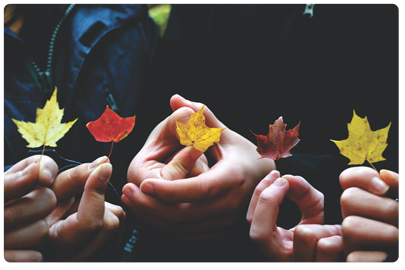
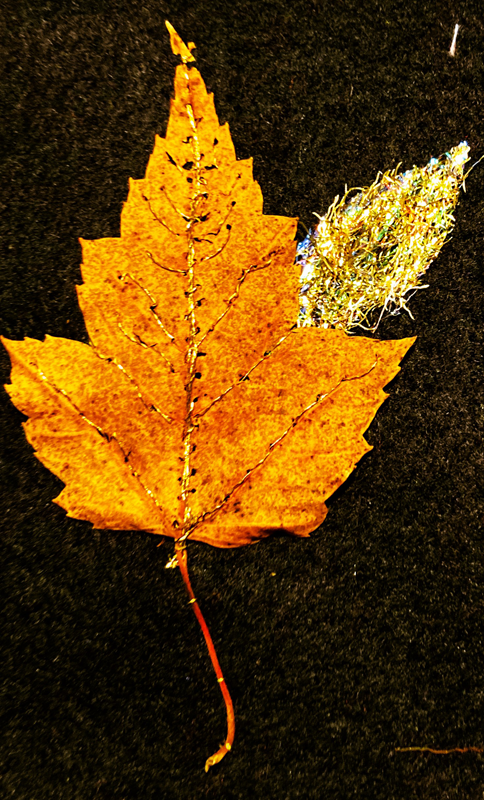
The fallen leaf will not last very long, it is quite fragile and will eventually turn to dust.
Unless … someone picks it up, brings it home, and thinks: “What if I embroidered her with gold thread, and gave her a small companion all brightness and sparkle?”
In my Focusing practice I sometimes come upon a part of me that gets my attention, that might need a bit of gold embroidery or maybe a companion who reflects light.
May we all use our precious gold threads and our luminous selves to greet and adorn the most fragile parts that seek our attention.
Denise Durocher,
maple leaf, Gold metallic embroidery floss, Angelina fibre, wool felt.
Seriously Playful with René Veugelers & Harriet Teeuw
by Caroline Moore
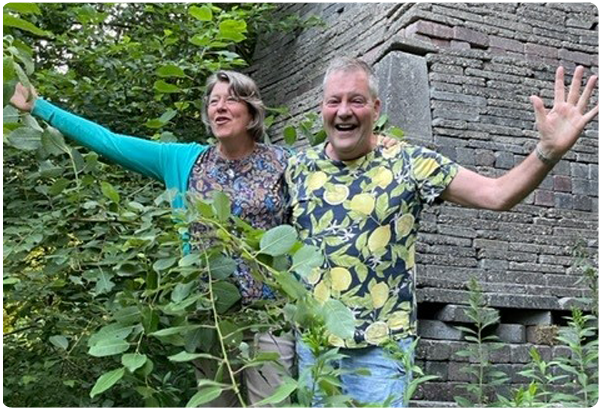
It was wonderful to have an opportunity to hear from René and Harriet again. I am always amazed by the deep sense of presence they both bring to their hostings, and how this always deepens my awareness of that moment and as a result, my connection with my Felt Sense. I am writing this seven weeks later, no notes, so I will stick to my abiding memories and Felt Sense of the session, which are strong still!
René and Harriet both showed videos of them working with children, and it was clear that both young people had been on a journey and come a long way in their ability to connect with Harriet/ René, but more importantly, themselves and their Felt Senses.
As I watched René’s videos, initially it seemed like nothing was really happening, and I wondered why René had chosen that particular snippet of their interactions. I felt I was missing the point - until I had my first ‘A-HA’ moment.
It was the subtlety of fully entering the child’s world and how it was for them. By fully embracing the child’s need to run/ dance/ move and joining in, while having no idea why or what was going on, the child felt deeply heard and acknowledged. It was both a process and a trust that had been building over time - René himself said he had no idea what was happening in the moment, but he was trusting in the child’s innate connection with their felt sense. It unfolded that this was a child who had been quite repressed and this was a ‘coming alive’ they were expressing and sharing, for which René was holding space and entering into - a landmark shift in this child’s way of relating!
René acknowledged his own felt sense of confusion and uncertainty with what was happening, then turned his attention to being present and listening/ reflecting for the child. He calls this ‘Listening in 3 Directions’ - which I understand as paying attention to his felt sense, the other has their felt sense, and he is also resonating with their felt sense. The level of holding and safety this brought was clearly felt by the child in their trust and freedom of expression.
I was struck by a couple of statements in particular which René made
- Having an unconditionally empathic attitude,
- How children can move in and out of felt sensing much more easily/ fluidly/ quickly than adults, and that we need to be aware of this so we do not limit this with adult expectations.
- He talked about how we can encourage felt sense connection through our language - how we reflect their words & what we draw attention to (like noticing and drawing attention to a thick line/ a dominant colour, but not putting meaning on it - opening it to the child to expand), and never asking ‘Why?’
- He stressed the importance of non-verbal communication - noticing and reflecting actions/ movements/ gestures/ tone of voice/ distance… Through verbal and non-verbal communication, our reflecting can make the Felt Sense explicit and deepen the child’s Felt Sense connection.
These themes were further deepened in Harriet’s video. Probably the thing that resonated most for me, was listening to Harriet talk about her earlier work with this child. She explained how he had created a lot of art with her and at the end of each session, he would ball it all up and throw that day’s work in the bin. Everything in me screamed ‘Nooooo!’ and I was amazed by her level of acceptance - ‘Ah, and something in you wants to put that in the bin’. I am still processing my reaction, and it has left an unsettling something in me - making me question so much of my work as a teacher - the implicit judgement in preventing the binning of work, the assumptions that there was anger/ dissatisfaction/ shame leading to him binning things - I realise these are all my projections and my assumptions of a need to protect him from himself! And there is more…
When we watched the video, I was struck by how this boy had reached a point of wanting to show and share his work with others - through the power of having that shared creative experience with Harriet through which he learned to negotiate/ discuss/ come to common agreements by connecting with their felt senses on the right next moves. (Again I am aware of my judgment of this as ‘good’!) And I could see how he transferred that holding of space and these learnings, to wanting to bring others into his experience. But it was only possible because he was allowed to fully express himself in that initial ‘binning’ process, and through Harriet’s acceptance of that was how it was for him at that time.
I came away from this workshop amazed anew by the subtlety and depth of the focusing process, particularly when used with children. I am left with much to ponder, which is still percolating 7 weeks later and challenging me to be a more accepting, more present teacher, but also to see the growth that can come from being less controlling and more trusting of the process. Thank you René and Harriet - a wonderfully rich experience as always!