




Book Study with John Keane and Aine Conaghan
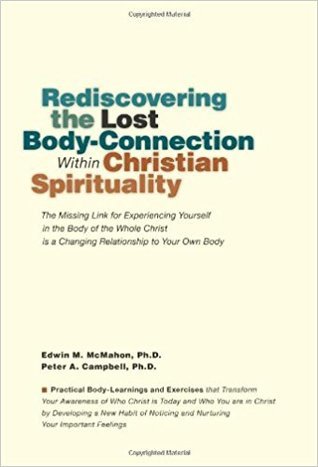
Rediscovering the Lost Body Connection within Christianity Spirituality (2010)
Edwin M. Mc Mahon and Peter A. Campbell
 It has been many years since I read a book on Bio-Spirituality by Ed and Pete. The above named book was completely new to me. I was captured from the first meeting as well as the recommended chapters to read before each session. It was a diverse group from many countries and I learned a lot from our reflections, questions, feedback and sharing in the break-out rooms. Aine opened the sessions with a range of guided settling and grounding experiences. The pace of the sessions was gentle and slow which tied in with one of the overarching themes of this book study.
The key areas we looked at were the practice of noticing and nurturing using the focusing process as described by Gendlin. We were invited to do a timeline of our lives exploring the lived experiences of feeling comfort and connection, termed as an “affectionate friend”. This was done most sensitively acknowledging that traumatic or negative experiences may have been part of our life stories. I enjoyed doing my timeline as it reminded me of the many experiences of people and special places that were my “affectionate teachers” and that I can continue to draw from now. From here on I shall use the term affectionate friend as this describes how the whole experience evolved for me. The process helped me to access some new affectionate friend experiences as well. We talked about times when we did not have an affectionate friend when we may have needed it, exploring ways we can bring our discovered affectionate friends experiences to all of that now. This reminds me of a comment by Dr Gabor Mate “No matter what happened in the past you can heal it in the now….. With a practice in developing self compassion and as well as reaching out for help, as this is how we are made, hardwired, for connection”. It is in relationships we are damaged and it is in relationships we are healed, a very human paradox.
We explored symbols and metaphors and the bodily mutual interactions with the felt sense. As a lover of poetry I had a profound experience at our in-person gathering in Dublin 2024. The description in this book described exactly my actual experience of focusing with a poem. The poem “functioned as a metaphorical bridge that interacted with a deeper felt sense, opening a door and carrying me across some visceral threshold into a different place and a transformed feeling within my own body. The words of the poem, as an explanation and information, in no way could account for the sheer visceral power of this interacting relationship between the poem as metaphor and my own body’s unique felt sensing. Gendlin suggests that there exists a deeper felt meaning, a felt sense within the body which can be accessed and encouraged to unfold further when interaction with an appropriate symbol or metaphor…allowing a further felt-revelation and visceral change to emerge from within” (Chapter 4) “Journeying into Your Own Inner World of Felt-Sensing” Pg 34. The something fresh and new that emerged for me was related to being with a loved one at the time of death. More was revealed about a connection to something beyond the whole experience. It felt like pure gift and grace in the now, just as described so eloquently in this book.
Three interesting further themes that resonated with me were process skipping, the philosophy of addiction in relation to church and faith, including the exploration of “Love your enemies” (Chapter 16) we explored this piece of scripture in relation to coping with physical and emotional pain. Bringing this approach to pain and illness has brought a tangible ease and relief to how I cope with this most natural human difficulty.
We were invited to watch out for times when we used distraction, numbing, avoidance (busyness) and substituting (food, alcohol, work, social media) as a possible way of process skipping. This helps me to pause and take some time to sense into how I am feeling or to use a focusing question from the book “What needs my loving caring presence just now?”
I was completely fascinated with the chapter on addiction and church/faith. This has expanded and deepened my understanding regarding current issues within church and connected me to my own living faith in a new and fresh way, feeling again like gift and grace.
To conclude, “Nothing changes and everything changes” has been my experience. These are also the words of a beautiful poem “Inviting Spaciousness” by Rosemerry Wahtola Trommer. The words capture for me a very deep connection into the wider field of focusing philosophy. I invite you to go onto the Poetry section of IFN website and listen to the recent recording.
I will be reading this book for years to come as I feel I have just began something fresh and new.
Thank you to John and Aine.
Marie Mc Guigan
The Empathic Moment in Focusing Partnership: When Breaking the ‘ Rules’ Brings Greater Depth and Connection.
by Mary Jennings
Gendlin lists four types of listening in his book Focusing:
1. Helping another person focus while talking
2. Using your own feelings and reactions about the other person
3. Interaction (in everyday situations)
4. Interacting in a group
Here, I will touch on the first two types as they might relate to Focusing Partnerships.
The first type, helping another person focus while talking, has evolved into the kind of ‘reflective listening’ we do in Focusing Partnerships. These partnerships have their own protocols such as, when you are the listener, being careful not to offer advice, not to comment on the Focuser’s process and not to put anything of your own experience into it. Focusers generally take care to abide by these valued practices.
Where might the second type of listening Gendlin outlines - Using your own feelings and reactions about the other person fit, if at all, within Focusing Partnerships? Let me make some suggestions.
I was introduced to what Tom Larkin calls The Empathic Moment in Focusing Partnership at a workshop last year. He was influenced both by this own long-term Focusing partners and by the work of Janet Klein on Interactive Focusing in presenting this practice. It was Janet’s discovery that listeners are touched by what the focuser says; it is part of the whole process/interaction, she suggests.
The Empathic Moment is an invitation to the listener to pause, to allow a sense of how the Focuser’s process has touched the listener. The listener then expresses their sense of how ‘all that’ has been for the Focuser and offers this as an ‘empathic moment’. That might come as a phrase, an image or a metaphor. It is, in some sense, it seems to me, an enhanced form of reflection. The Focuser checks if what the listener say about their process fits and, as ever, the Focuser is in charge and may respond in a way that is right for them.
Very often, as this is done with empathy, it deepens the Focuser’s own experience as well as deepening the connection between listener and focuser. It is important to say offering this ‘empathic moment’ can be part of a Focusing Partnership only where there is agreement – in advance – that this will be included as part of the process. It seems to fit with what Gendlin is referring to in this second type of listening of using our own feelings and reactions about what we have heard. It also fits with his wider concept of ‘interaction first’ which he outlines in A Process Model.
This idea of using The Empathic Moment may be of value to you – or not – in a Focusing Partnership situation. Initially, when I first tried offering this practice, I experienced some unease by seemingly ‘breaking the rules’ of what is considered good practice in partnerships.
You will see in the video clip that the initial interaction is based on the tried and tested Focusing Partnership model, with accurate reflection and checking if any word I used that was different to what the Focuser said, fitted. It might have ended when the ‘felt shift’ came for the Focuser and that would be fine. The Empathic Moment follows on from that and is done only when the listener has checked if the Focuser’s process feels complete for now.
See what the sense of The Empathic Moment is for you and if this is something you might consider in your Focusing Partnerships. You might like to try it with curiosity and care.
Creative Corner: The Smallest Thing
by Denise Durocher
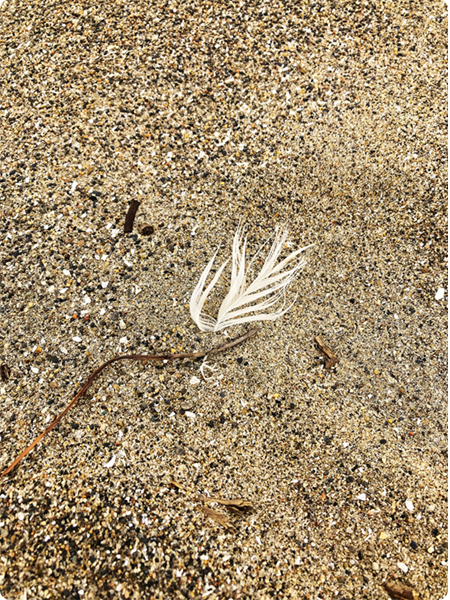
Photo: Denise Durocher, Seacliff Beach, Leamington Ontario
Walking on a large beach on Lake Erie (Ontario) I was purposefully searching for very small objects.
I was attracted to this little feather being whipped around in the gusty wind. It’s littleness in the bigness of the beach made me stop for a moment to admire it and to take a few photos.
What I thought was how this very small feather was once part of a bigger entity, the seagull, and played a part in the bird’s life. It helped it to fly, it contributed to its buoyancy when it rested on the water, it helped it keep warm and dry.
In Focusing, I have often found that exploring the smallest voice, feeling or thought, often shows me how they are part of the big picture. They have contributed to my well-being especially in difficult times. Lately, in a Focusing session, the small voice inside had two words to offer:
“For now”.
My Focusing Journal - Nina Trebec
BOOK REVIEW by Tom Larkin
My Focusing Journal - Nina Trebec
Sometimes after a Focusing exchange, when I want to make a note about what I have learned/ experienced, I have to scramble around looking for something to write on. More often than not, I have used the backs of envelopes or my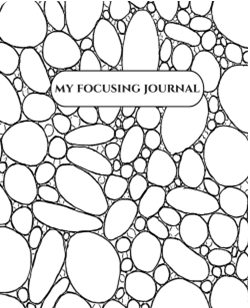 phone to record whatever it was that I wanted to remember or that seemed significant. I didn’t know it then, but this little booklet was what was missing at those times. Nina Trebec has done the Focusing world a great service by providing a comprehensive framework for a systematic reflection on formal (or informal, ‘on-the-go’) Focusing experiences.
The booklet contains 50 guided reflections with eight prompts/questions/suggestions spread over two pages. In these pages one can describe one’s felt sense, different ‘somethings’ or parts that emerged, the dynamic between Focuser and companion, insights gained, next steps and more. There is also a (relatively small) space to express one’s Focusing experience through doodles/drawing/art. Nina suggests that writing about our Focusing sessions can help Focusers with reflection and integration after a session, getting to know oneself better and honouring and loving all one’s parts, by writing about them.
I imagine that this journal would be particularly helpful for people in the early stages of their Focusing journey (say the first ten years or so!). From my experience of trying it out for this review I can say it is also useful for more experienced practitioners. There are a lot of other guided reflective journals out there for planning, meditation etc. – I think it’s great to have one dedicated specifically to Focusing.
Currently the journal seems to be only available from amazon.co.uk.