




Focusing and the Enneagram
by Therese Ryan
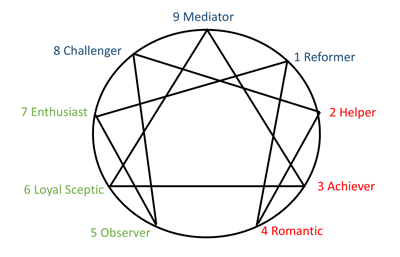
The Enneagram is a powerful psychological and spiritual system which helps us recognise our ingrained patterns of thinking, feeling and behaving. Decades ago, when the Enneagram began to be widely taught, type patterns were something to be gotten rid of. Now, in the Enneagram world, it’s all about understanding, appreciating and befriending our type patterns. And this is where I get very excited about how the Enneagram and Focusing compliment each other and invite us into a deeper relationship with ourselves.
Discovering my Enneagram type was the beginning of an ongoing exploration of the mainly unconscious survival strategies that helped form my personality. I lead with type six patterns. There are certain themes that resonate for everyone who lives with these patterns – doubt and anxiety among many others. And yet my lived experience of my “sixness” is unique to me, to my inner world.
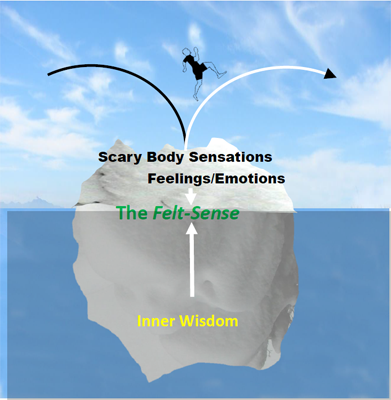
Sometimes it seems that there’s nothing new for me to know about doubt. Focusers, however, understand that what our body has to say about who we are and how we are is often a surprise. When I take this word, doubt, freshly inside, Focusing makes it possible for me to peer into doubt’s dusty corners, to teeter at its edge and to discover something in me that’s strong and assured, an inner platform of support. In this way, the felt sense of a familiar theme is a doorway to who I am beyond my patterns.
We encounter our Enneagram patterns in all areas of our lives and of course they show up too when we Focus, perhaps in our anxiety about doing it “right”, or the gush of overwhelming emotions, or the difficulty in sensing into the body at all, or the push to get somewhere. Understanding my Enneagram patterns has helped me recognise and understand what gets in the way of me being present, not just when I Focus but in life.
The Enneagram unflinchingly points out our blind spots too. My suspicion for example, has been difficult to honestly acknowledge and yet Focusing enables me to attend kindly to whatever I discover within myself. My patterns often feel fixed and limiting, a block to my living process and yet through Focusing I’ve come to trust that that they too hold an implicit intricacy which offers freedom.
Both the Enneagram and Focusing see each person as a living process, always changing, longing to live life forward. Focusing with the Enneagram has enhanced my experience of both. Together they offer a way to navigate life. The Enneagram is a map showing us where we are, how we get stuck and pointing us in the direction of growth. Focusing is the compass that helps us find our way.
Process Skipping Online Workshop Reflection
By John Keane
In April and May this year, I offered an online workshop on the subject of Process Skipping. The group (40 people) met each week for 4 weeks for 2 ½ hours each week.
In my years of teaching BioSpirituality, I have come to appreciate the importance of this process to healthy human development. And, I have come to the sense that it is a process that needs time, space and gentleness to fully engage with it.
This program examined Process Skipping, a process identified by Eugene Gendlin and further developed by Frs. Peter Campbell and Edwin McMahon. Process Skipping is characterised by an unconscious avoidance of uncomfortable feelings or emotions. As such it can be a barrier to being lovingly present to what may need our attention. By understanding and addressing Process Skipping behaviours, individuals can find freedom from control and domination, engaging more authentically with reality.
Program Structure:
- Personal Exploration: Participants are invited to identify their own Process Skipping behaviours.
- Cultural Context: Examination of how cultural structures influence Process Skipping.
- Alternative Perspectives: Investigating love and its embodiment as alternatives to control and dominance.
The essence of this process is that it is now a maladaptive stress response. Its initial purpose was to prevent or minimize some perceived conscious or unconscious pain. This process becomes habitual over time.
Process Skipping can operate on a number of levels which we explored during the program.
- Mental or Rational Process Skipping
- Activity or behaviour Process Skipping
- Emotional Process Skipping
- Physical Process Skipping
At the beginning some of the participants expressed their reluctance about exploring this well defended aspect of our living. I acknowledge that it requires courage to engage with this program. BioSpirituality is not about doing therapy (although many therapeutic benefits can be gifted to us in this process). So, it is important to stress to participants, that if they discover process skipping mechanisms that may be harmful to themselves or others – they should seek the appropriate therapeutic help and guidance.
As the workshops progressed the support of the group was important as participants became aware of their process skipping patterns. There was the realisation that we all do this – and many shared that it also gave them an understanding and an empathy for friends and family that have their own expressions of process skipping.
There was a sense of wonderment in the group about how clever we were to protect ourselves initially when we encountered danger or stress. But also, a sense of relief, that we don’t need to do that anymore. Those parts of ourselves that were lost can become our greatest teachers and treasures.
It was also clear that the group developed a sensitivity and appreciation about the relationship between process skipping and addiction. Pete and Ed always stressed that some element of process skipping is evident in most cases of addiction. We are no longer powerless about this when we become aware of this process that is initially unconscious.
It was also clear that this program did not provide enough time for people to explore as deeply as they desired. This was the first time I have offered this workshop, next time I will provide more time. Time for refection between sessions, and more sessions to engage with the intricacies it reveals.
In essence, awareness and exploration of process skipping in both personal and cultural terms is a call to live into and develop a sensitivity for love and gentleness. It is akin to a kind of conversion experience, when we discover that we no longer need to control and manipulate our feelings. Living into these feelings and experiences can set us free. We begin to live life as it is – and not how we might wish it were. There is freedom beyond control…
Children and Focusing Intro Day Experience
by Ann Harte Barry
Last June I attended my first IRL (in real life) focusing event since Covid. And what a wonderful re-entry it was!! I was really happy to meet old friends, to meet Zoom companions and to meet focusers I had not met before - and to feel that all 17 of us are all on the journey together.
The Children and Focusing Introduction Day, led by René Veugelers and Elaine Goggin, was held in the Dominican Retreat Centre, Tallaght – a very suitable venue in terms of welcome, comfort and accessibility.
The advertising blurb stressed that the training was not only for professionals working with children but ‘also supports and deepen your own process’.
That was so true! I personally found that while there was some stress on children all the exercises and teaching everything spoke directly to the various levels of child in me! It was immensely helpful. We were told that ‘you can’t move faster than your slowest process’. This is such a helpful starting point as often I am impatient, wanting ‘results’ and forgetting that other piece of wisdom shared: ‘the answer is already unfolding underneath’.
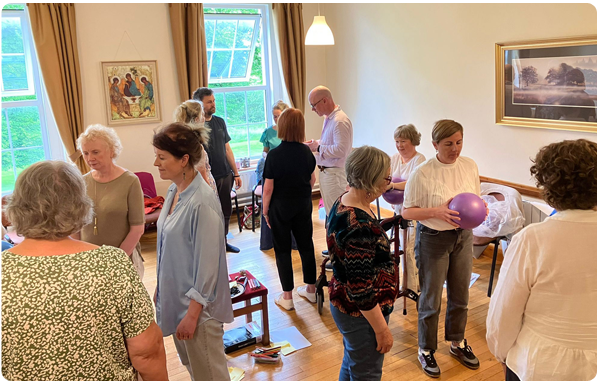
 The day was very helpful in helping me remain with the process and allowing what needed to emerge to emerge! The resources were creative and well designed and really helped my process. Of course the highlight was the use of emoji balls which ticked so many boxes!!
During the course of the presentation I did become very clear how focusing can be a powerful positive energy in working and being formally and informally with children.
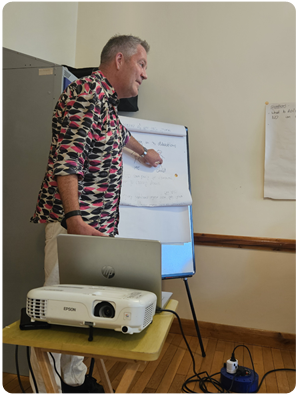
René’s powerful sharing on his work with a young person demonstrated the power of living focusing attitude, creative process suggestions and staying close to the felt sense, all done in a dynamic sensitive and fragile setting. We were blessed to receive this sharing and deep within I believe that in some mysterious way that we were compassionately present to the young person’s life and who knows how the power of that energy has rippled out from our group supporting his search for fulness of life.
The Invitation: to consider training for focusing with children. It was clear that the day was a ‘taster’. Certainly I am very convinced of the potential of focusing with children and can see that the training would be stimulating, deepening and enjoyable.
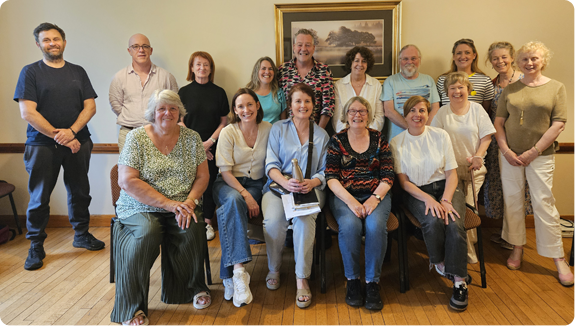
Group attending Children and Focusing Introduction Day in Dublin - 28th June 2025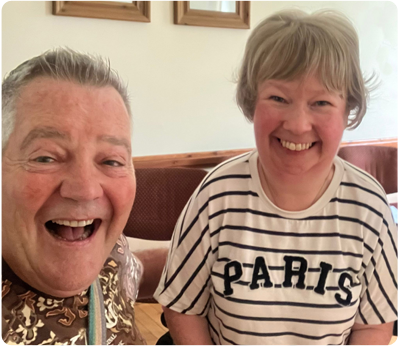
Facilitator Renè and Elaine
Planting an Olive Tree in Iceland!
by Margaret Quinn
Where to begin……
The story of how we found ourselves leading a training course for people who would facilitate a programme designed to promote resilience among refugees and asylum seekers in Iceland begins in another place and another time.
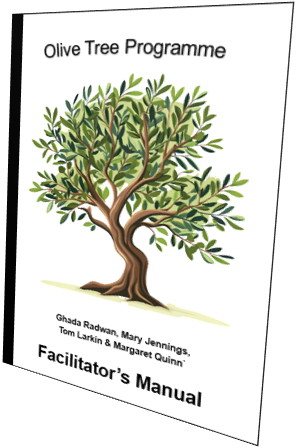 In 2011, Mary Jennings and Gerry Conway were invited to travel to Gaza to work with the Palestine Trauma Centre (PTC). The initiative was sponsored by the Quaker Community in Galway and the UK and had the aim of teaching basic Focusing skills to the personnel of PTC. In 2013, they returned to Gaza, this time accompanied by Rene Veugelers, to explore ways of using Focusing with children. The team then created a twelve session programme for community groups which would be offered by PTC. Delivery of that programme was led by Ghada Radwan, who translated the programme into Arabic and worked to ensure that it was culturally appropriate and included multi-modal approaches – using art and drama for example.
Over time, Ghada developed an interest in deepening her Focusing practice and becoming a Focusing Trainer herself. Her great desire was to share Focusing with others in Gaza, particularly those who could bring Focusing to their work as psychologists, teachers etc. Ultimately, she hoped to train Focusing trainers in Gaza. Mary undertook to support Ghada through her initial training process and became her primary mentor. It was during this time that Ghada connected with the newly emerging Irish Focusing Network. Some of you will have met her during online courses she joined during the pandemic.
Having completed her Focusing training, Ghada invited Mary, Tom Larkin and myself to support her in preparing a training programme to expand her work in Gaza. When we had completed the first part of this work, Ghada began to work with a group of psychologists. It was interesting to hear that they found the Focusing approach fresh and different. Many wanted to continue their training. We were beginning work on the second phase of that project when war broke out.
There are so many ways that work can be disrupted, or projects derailed – illness, relocation, personal circumstances. What actually happened was beyond anything we could have imagined. Not only did the work stop, but, for long stretches of time we lost contact with Ghada and were left wondering if we would ever hear from her again. We worried for Ghada and her family, we felt helpless to offer support other than the messages we sent. Destruction of the communication infrastructure in Gaza meant that very often those messages were met with silence. We would wait, sometimes for weeks, for any response which would let us know that they were still alive.
As the months passed and we watched the horror unfold, Ghada and her family were displaced several times, two of her nieces died when a bomb targeted a house close to where they were sheltering, food and water became more difficult to find and communication remained sporadic. Finally, Ghada, Mohammed, Eilia and Elite were displaced to a tent in Rafah.
Our Focusing project was stymied, so Ghada turned her attention to the other needs she saw around her. It came as no surprise to us to discover, in occasional messages, that she was supporting mothers in Rafah to access food and supplies for their babies. Accessing support from “Challenge to Change” she was able to help 50 families to keep their babies fed and clothed despite the awful circumstances. Above all, her energy was focused on keeping her daughters well and encouraging them to retain hope of a better future. She has told us that drawing on Focusing during this ordeal was a great support. As the assault on Rafah began, however, Ghada and Mohammed decided that, to protect their children, they had no option but to leave Gaza. The story of how this was achieved would take a novel and strain belief. Suffice it to say that the efforts of many friends and the brilliant co-ordination of efforts by Sigríður Þorgeirsdóttir, who works at the university of Iceland, and Donata Schoeller, who many of you know from her courses with the Focusing Institute, resulted in the family leaving Gaza on the day before the Rafah crossing closed for good – making departure impossible.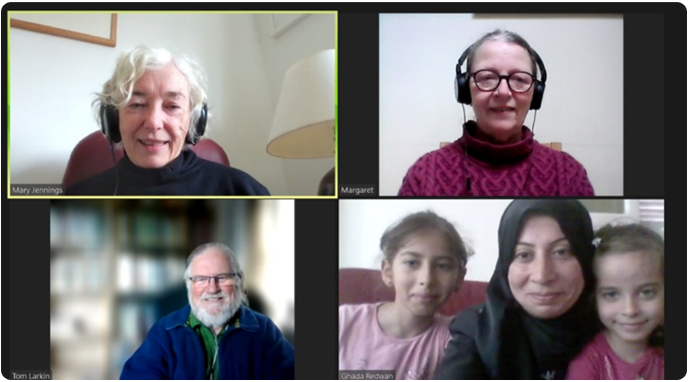
In Cairo, Ghada once again had access to the internet and I can still remember what it felt like to see her on Zoom during that first meeting. I remembered the story Ghada told us about the woman in Gaza who said “I am not waiting for death, I am seeking life.” This resilient little family despite having to leave behind home and family, sought to live meaningfully in this no-ones-land that was their time in Cairo.
This was when our shared project entered a new phase. Never one to waste time, or stint energy, Ghada wanted to offer some support to displaced Palestinians in Egypt. Our thinking was that we could best support them by creating a programme designed to reclaim or re-build resilience. The Olive Tree project was born.
While it was difficult for Mary, Tom and me to imagine how this could be organised, Ghada was already in touch with groups like “Challenge to Change” (a Swiss charity) and exploring ways to offer the programme to online to Palestinians in Egypt, Lebanon and Jordan. She’s not a woman to let the grass grow under her feet. We went back to our planning meetings and hammered out an approach which blended Focusing with Psychological first aid models, mindfulness practices and insights from neuroscientific research.
While it was difficult for Mary, Tom and me to imagine how this could be organised, Ghada was already in touch with groups like “Challenge to Change” (a Swiss charity) and exploring ways to offer the programme to online to Palestinians in Egypt, Lebanon and Jordan. She’s not a woman to let the grass grow under her feet. We went back to our planning meetings and hammered out an approach which blended Focusing with Psychological first aid models, mindfulness practices and insights from neuroscientific research.
As the work continued, it became clear that remaining in Egypt long term might not be possible and, thankfully, Ghada’s friends in Iceland again came to the rescue, supporting her application to study at the University of Iceland.
So what now for the Olive Tree Programme? Online offerings were a possibility, but how to do it? The programme was coming together and we believed it would be useful, but, as Gendlin might put it: “What’s possible now?”
We reckoned without the creativity and “go-for-it-ness” of Ghada, Sigríður and Donata as well as the generosity of the Icelandic government and “Challenge to Change”. An application for funding was successful and before we knew it, Ghada was asking us if we could be available to travel to Iceland to train a group of facilitators to deliver the Olive Tree Programme to Arabic speaking refugees and asylum seekers there! Who could say no?
In late May, as we took our seats on the plane, Mary turned to me and observed – in a tone of complete astonishment – “We’re going to Iceland!” There had been so many obstacles and challenges along the way. What had started out as “notes for Ghada” had to become a manual which would be accessible to people who knew little or nothing about Focusing – it took months! This new iteration of the programme also involved adding a layer of facilitator training – another manual for us - no small task in itself. Then there was the organisational end – travel arrangements, venue and the rest – all brilliantly handled by Una Þorláksdóttir. The decision to proceed was not without its worries either. We were setting out to offer training to a group we had never met, about whom we knew very little except that several of them worked with Arabic speakers through the Red Cross or Municipal authorities in Iceland. A small number of the group were Icelandic and were familiar with Focusing or TAE.
We need not have worried. From the moment of our arrival, our Icelandic friends went out of their way to make us welcome and to ensure we had every support for the work. Ghada, Mohommed and the girls welcomed us like family and it was wonderful to have an opportunity to spend time with them. We are grateful to Sigríður, Una, Elsa and Gugga for all they did to support this project. And then there was the group of trainees….. welcoming, interested, engaged – all we could have hoped for. The six day training was intense and demanding. They met every challenge and working on the programme became one of those wonderful experiences of collaborative effort.
We are currently in conversation with this group as they prepare to offer the Olive Tree Programme to their clients. Translation into Arabic and (we hope) Icelandic is underway, which will make this easier for the facilitators and more accessible for those who can benefit most. What the future holds for the programme is an open question, but our experience over the past several years, particularly the most recent, have left me thinking that anything could happen – and feeling open to that. For now, it is enough that this lovely group of people will carry the programme forward in Iceland while we explore how it might make an impact in Ireland and/or elsewhere.
Reflecting on the entire experience, I am, above all, grateful that this project offered a way to do something useful at a time when – perhaps like many of you – I felt utterly helpless in the face of the daily images from Gaza. That the situation continues to worsen by the day still shocks and horrifies me. Ghada remains deeply concerned for her family members who are still in Gaza – suffering the fear and privation we see on our screens every day. This project is, for me, an attempt to light a small, frail light in an encircling darkness and I am deeply grateful for that. As I am grateful for the opportunity to work with Ghada, whose resilience, determination and generosity continually leaves me awestruck – and inspired.
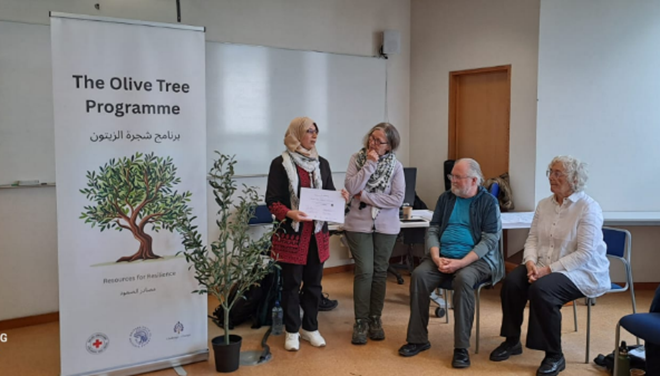
From left: Ghada Radwan, Margaret Quinn, Tom Larkin, Mary Jennings.
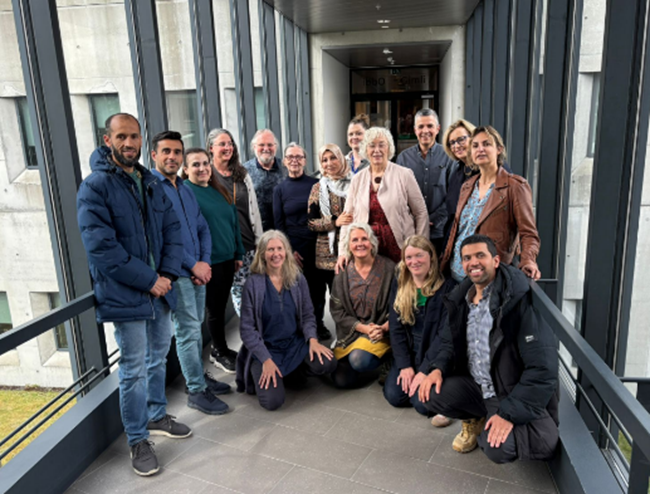
In front, from left: Guðrún Arnalds, Helga Arnalds, Guðbjörg Jóhannesdóttir, Osama
Mubarak Al Hijazy,
Standing, left to right: Ahmad Seddeeq, Mohammed Raheem, Reema Abdalhakeem, Kerryn
McMurdo, Tom Larkin, Margaret Quinn, Ghada Radwan, Elsa Haraldsdóttir, Mary Jennings,
Salah Kareem Mahmoud, Sigríður Þorgeirsdóttir, Soumia Islame
Here is a wonderful documentary on our project