



Gendlin Movie Bites Gatherings
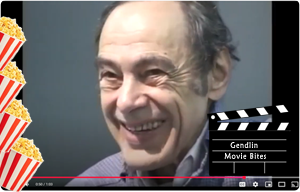 Who doesn’t love Mary’s moments of inspiration, especially when it doesn’t involve you having to do anything except show up and enjoy! One of Mary’s more recent bright ideas was to hold a movie night featuring Eugene Gendlin's work captured on video, which the International Focusing Institute had complied on their YouTube channel. Many of the clips involved the generosity and tremendous work of Nada Lou. Nada carefully combed through hours of footage of Gene sharing his wisdom with groups, and condensed it down into digestible bites to nourish us all.
Key themes were on how listening, which Gene learned from Carl Rogers, became such an important feature – it didn’t feature in the first stage of Focusing, strange as that might now seem. We heard Gene on Focusing Partnerships, on his concept of ‘carrying forward’ and his emphasis on ‘action steps.'
Nada-remarked at one stage that her husband felt like Gene lived in the house with them as he heard so often, while editing the videos. We were honoured to have Nada as a guest at the Irish Focusing Network Gathering which was a wonderfully light and informative evening for us all. Mary’s careful selection of videos held a really nice Focusing flow through the themes.
Nada carefully combed through hours of footage of Gene sharing his wisdom with groups, and condensed it down into digestible bites to nourish us all. Nada remarked at one stage that her husband felt like Gene lived in the house with them as he heard so often. We were honoured to have Nada as a guest at the Irish Focusing Network Gathering which was a wonderfully light and informative evening for us all. Mary’s careful selection of videos held a really nice Focusing flow through the themes.
Following on from the Irish Focusing Network evening, Mary held a Roundtable on it for TIFI and again it was very well attended and thoroughly enjoyed by all. It was a very engaging experience, with some interesting contributions on Gene’s philosophy and how that influenced the shape
of Focusing as we know it. Nada very graciously answered questions about clips and broadened our
perspective on Gene’s wisdom.
We are grateful to Mary for opening the door to what feels like a beginning of further gatherings like this together. And if you want to do another one Mary, I'll have the videos ready for you without ads!
Here is the link to the section of the TIFI website that hosts many videos featuring Gene talking about a range of topics - Gene Gendlin Videos- Click here. We hope you enjoy exploring more.
Below is a list of the videos we viewed on at the event with a link to the TIFI YouTube channel where they are hosted. We invite you to explore these in your own time and it might be worth hosting your
own ’movie bites’ and sharing the wisdom – and may popcorn with some Focusing friends.
1. Why Focusing works and what it is not
2. On listening, reflecting and on Focusing Partnerships
- What I learned from Rogers - with Eugene Gendlin Ph.D.
- Gene Gendlin and Lynn Preston on Reflecting
- The Pros and Cons of Focusing Partnerships
3. On carrying forward and action steps
4. On Focusing and teaching Focusing
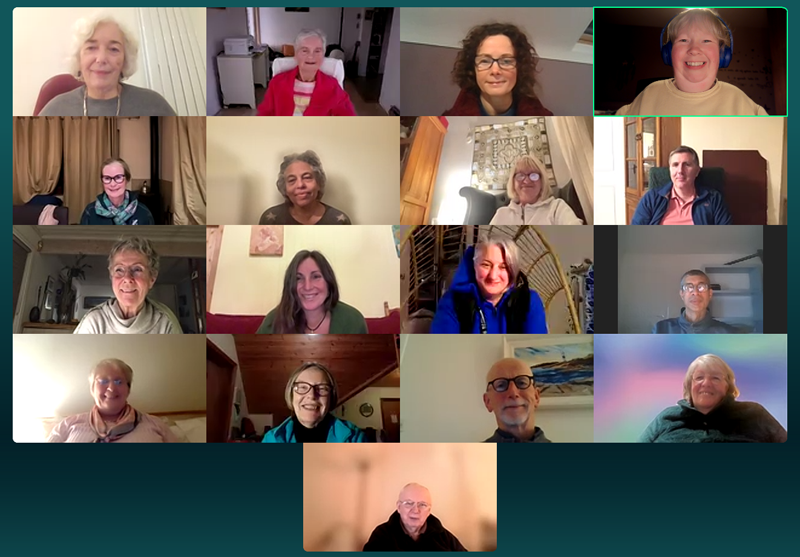
Irish Focusing Network Movie Night - 27th November 2024
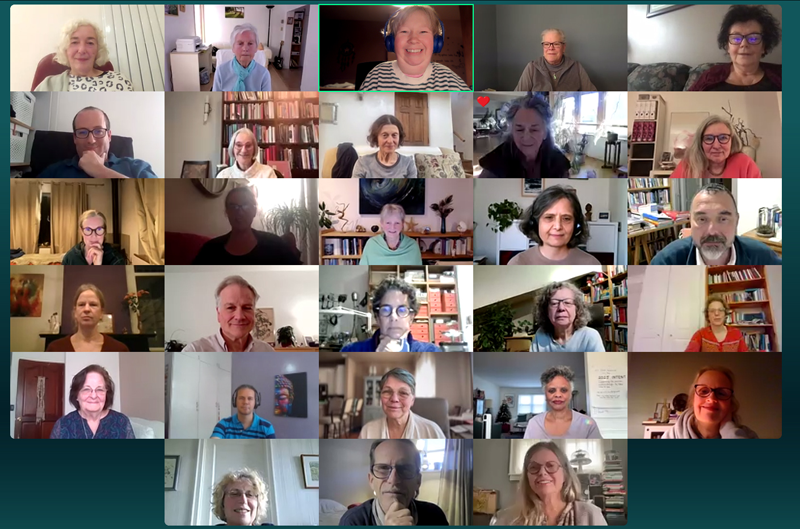
The International Focusing Institute - Roundtable 28th January 2025
Written by Elaine Goggin
IFN Committee Update Feb 2025
Spring is almost here and along with the lengthening days, we look forward to our annual Spring gathering which will take place on 5th April in Elaine’s home village of Ardpatrick Co Limerick. Please save the date. We look forward to seeing many of you there.
Our AGM which took place in January provided an opportunity to reflect on 2024. In April Marta Fabregat kindly hosted a beautiful day in Gort, Co Galway. Our Autumn Gathering took place in the Dominican Centre in Tallaght in September.
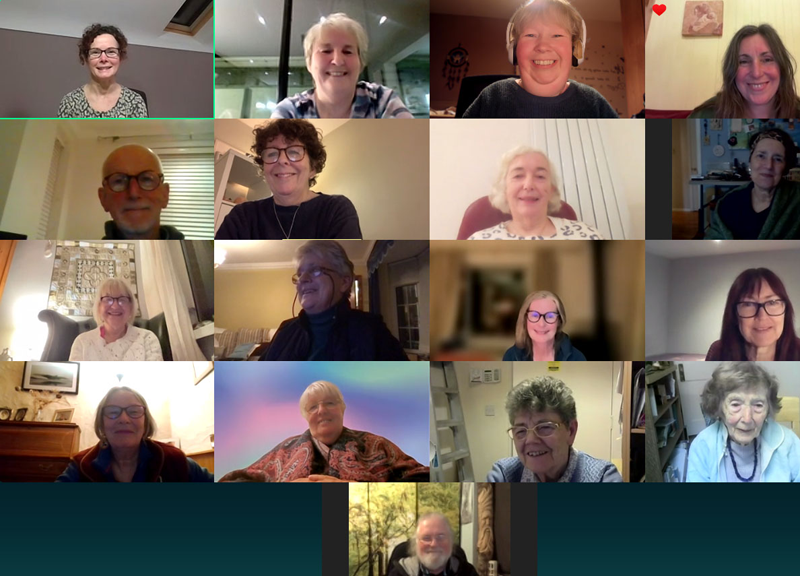
AGM 2025 Screenshot
We also had an active year online. In May, Gordon Adam from the British Focusing Association facilitated an evening with the theme of Focusing in community. In November, Mary Jennings facilitated a Movie Bites evening where we viewed video clips from the TIFI library. We were privileged to have Nada Lou join us for that evening making it a very special occasion for our network.
Much appreciation was expressed at the AGM for the many activities and resources offered by members: the bi-monthly poetry evenings, our weekly zoom sessions, and of course our wonderful newsletters. Many have also enjoyed listening to the Focusing Pathways podcasts.
A desire to encourage and develop good Focusing practice led the committee to organise a series of monthly Listening Skills Refresher evenings which were generously facilitated by our wonderful Focusing teachers. The dates of upcoming evenings are March 31st, April 28th and May 28th. We’ve been delighted and encouraged by the attendance and would love to see them continue. If you’re a Focusing teacher and would like to facilitate a Refresher evening in the future, please get in touch.
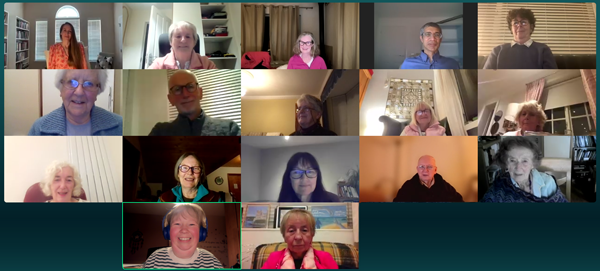
Screenshot from Anne Lawerence's class
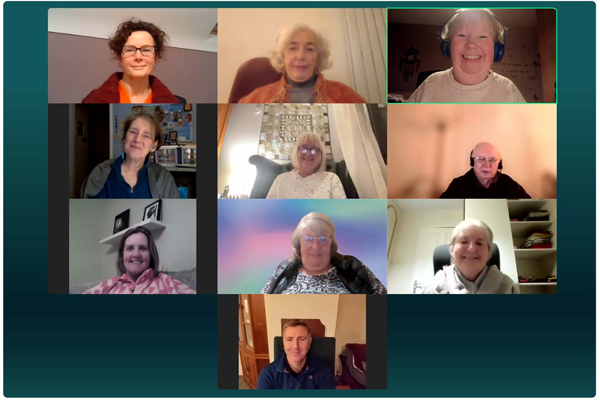
Screenshot from Therese's Ryan's class
Our heart-filled thanks to everyone who supports the network: those who facilitate the workshops for our in person gatherings and our online events including our Refresher evenings, to our zoom hosts who keep the weekly zoom sessions going smoothly, and to those who produce our newsletters, as well as the committee who work behind the scenes.
Suggestions offered during the AGM included: an email address for raising specific concerns which may arise, the possibility of organising a conference or larger workshop to promote Focusing and support the growth of our network, a space for sharing the rich Focusing stories of our members.
The committee is currently drawing up guidance for good Focusing practice in order to nurture and maintain a sense of safety within our community and to promote respectful connection. We will be sharing these guidelines with you all by email in the coming weeks.
It’s the time of year to renew your membership, so if you haven’t already done so, please take the time to register using the link by clicking here.
We are delighted to welcome some Focusing friends from Iceland to our network. Please look out for them at the zoom sessions and make them feel welcome.
Finally, we encourage you to consider how you might contribute to growing and developing our network. It may be helping out with the newsletter, becoming a host for our weekly zoom sessions, offering a workshop online or at one of our in person gatherings, or spreading the word about Focusing. There are lots of opportunities to become involved. We depend on all of you, our members, to keep our network alive and growing and thriving. Thank you for your ongoing support and commitment.
The committee members are:
Chairperson Therese Ryan
Secretary Kay McKinney
Finance Officer Peter Duffy
Elaine Goggin
Marta Fabregat
Worlds of Focusing: Interactive Focusing
Interactive Focusing is a form of Focusing that was developed by Janet Klein (d. 2010) with the help of Mary McGuire. IF has been described as a ‘third stage’ of Focusing, beginning with Focusing alone, then Focusing in partnerships and now Interactive Focusing.
Janet developed Interactive Focusing while working on a PhD in Psychology. For her thesis she focussed on Focusing partnerships.
She observed and interviewed Focusers who had long-term, ongoing Focusing partnerships. For their exchange, she asked the partners to Focus with ‘what their partnership and their partner meant to them. She discovered that these Focusers hadn’t ever articulated what this meant to them before. In addition, she realised that Focusing partnerships were, in fact, interactive even though “there was a strict prohibition against touching the material of your partner”.
She describes it this way, “The partnership was set up on the lines of a transaction, two equal but separate pieces. The listener was to clear the space of her own issues in order to make room to listen to the Focuser. When they exchanged roles, the second Focuser wasn’t to touch on the material of the first Focuser. It became apparent to me, however, that there was a subterranean interaction, though it never had a chance to surface due to the prohibition. I wanted to frontally address this unspoken aspect.”
As a result of her findings, she created a structure, Interactive Focusing, (IF) that would allow for interaction while ‘preserving each person’s material and boundaries’. Following this kind of interactive process would allow the partners to safely process their relationship, if they wanted. Barbara Dickinson describes it thus, “A regular practice of IF creates a sort of “space” between two people where they can bring their individual issues as well as issues that affect both people in the relationship.”
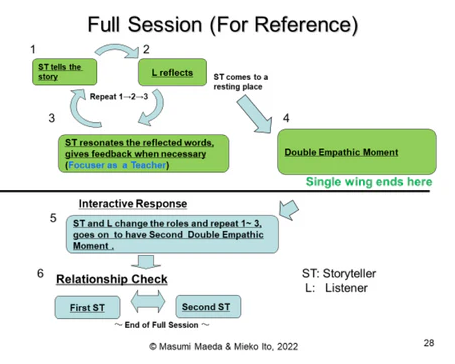
There are several stages to a full IF process. The following is but a very brief description. See below for further reading/resources.
An IF session begins in a similar way to a usual Focusing session; one person Focuses first for the agreed time while the other person listens/reflects. Then, in a departure from most Focuser’s experience, at the end of that part the listener offers an empathic response to the Focuser, usually in the form of a symbol. The Focuser responds to this. This form of Focusing requires that the Focuser say enough during their time so that the listener can actually respond. (In my experience, more and more long-term Focusing partners are bringing this element into their Focusing exchanges.)
Then it is the turn of the second Focuser, who begins by checking inside to see what has touched them from the session so far. They then continue in the usual way to explore their experiencing while the second listener listens/reflects. At the end of that, the second listener offers an empathic response and the Focuser responds.
After the above and to close the session, both partners in turn now have a ‘relationship check’. Each partner addresses the following questions or similar in a Focusing way; “How am I with myself?” and “How am I with my partner?” while their partner listens/reflects.
 As well as helping to deepen the relationship between Focusers, particularly those who know each other well, Interactive Focusing process can be used for dealing safely and effectively with conflicts and for healing troubled areas in relationships.
If you would like to explore this form of Focusing further you can check out the websites below. The book on the method is available from TIFI bookstore and Nada Lou has a video of Janet and Mary Maguire explaining, explicating and demonstrating the process. If you would be interested in an introductory, day-long, in-person workshop to experience this method please contact me at This email address is being protected from spambots. You need JavaScript enabled to view it..
Further Reading and Resources
https://focusing.org/more/dr-janet-klein
https://www.youtube.com/watch?v=tOfIpVpY1Ek&ab_channel=LynnPrestonFocusingRelationalPsychotherapy
https://focusinginternational.org/resources/interactive-focusing/
https://learnfocusing.org/en-gb/pages/interactive-focusing-resources?_pos=1&_sid=69ae60f9f&_ss=r
https://www.cefocusing.com/wordpress/interpersonal-focusing-kleins-interactive-focusing-protocol/
BOOK REVIEW: Self Therapy: A Focusing Guide
Campbell Purton – Self Therapy: A Focusing Guide. Athens: Eurasia Publications (2022)
Campbell Purton is an English Focusing teacher. His career somewhat mirrored Eugene Gendlin’s in that he studied philosophy to PH.D. and then trained as a person-centred counsellor and Focusing teacher.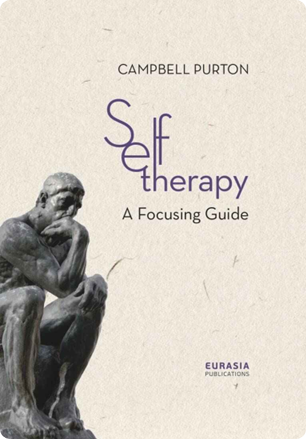
The cover of this relatively short book shows Rodin’s sculpture, ‘Le pénseur/The Thinker’ – an apt image for how, in his introduction, Campell describes Focusing as “giving sustained attention to our trouble in a way that leads to steps of change" (p.15). He also suggests that in the sculpture’s stance of stillness and apparent waiting and attending, Focusing may be likened to a kind of ‘pondering’ (p.109).
While set as it were in the world of psychotherapy it is primarily a book about Focusing and more specifically Focusing alone. At the outset he says that the book is intended as a self-help guide to working with the kinds of difficulties that move people to seek counselling help. From a therapy perspective he sees Focusing having a place alongside psychotherapy in the same way that complementary medicine can have a place alongside traditional medicine and possibly as a way of continuing the process after formal therapy sessions have ended. His first chapter is a broad, wide-ranging review of the psychotherapeutic scene particularly in the UK and of Focusing Oriented Therapy.
In the following three chapters Campbell, adopting the Gendlian approach, explains and explicates the classic six movements of Focusing, along with an exploration of some of the difficulties that can arise and how to work with them. He provides a wealth of examples of Focusing experiences, some of them quite detailed. He points particularly to the role of metaphor in the process and draws on the analogies and metaphors of Lu Ji a third century, Japanese lyric poet.
There are some aspects of Focusing that he repeatedly emphasises throughout the book; the usefulness and effectiveness of Focusing in everyday life; deliberately not attending to the familiar details of a problem or difficulty when beginning a Focusing session; “… keeping of our attention on the problem as a whole, while allowing new details to emerge” (p.37); “attending, not so much to what is already there, but to what is on its way, or what could come if we give it a chance” (p.38).
Chapters dealing briefly with Trauma and with Moods and Medication are interesting and informative. In regard to the former particularly, while he commends the use of Focusing he urges caution about going it completely alone. There follows an important chapter on Action Steps, an often glossed-over or neglected aspect of Focusing. Finally, there is the chapter called ‘How does it work?’ which he says is for those people who are curious about what is involved in the process of Focusing and which looks at some of its more philosophical aspects.
Though he writes in a deliberate, methodical way, as becomes a philosopher, the book is very accessible. It is probably most suitable for counsellors/psychotherapists and people who have already begun their Focusing journey or/and those who have some familiarity with the process. Experienced Focusers would benefit from his distinct perspective on Focusing. I think this is a welcome and helpful addition to the growing library of books on Focusing.
Campbell has written a number of books on therapy and Focusing and many articles on Focusing, Buddhism and Philosophy (see his website for a list and access - http://www.dwelling.me.uk/focusing.htm)
Written by Tom Larkin