



Focusing and the Frequency Illusion
by Clare Myatt
If you’re reading IFN’s wonderful newsletter, you’re probably already a devotee (is that the right word?) of focusing. I most definitely am a devotee (it’s the right word for me). To say it has been transformational in my life sounds rather grandiose, but that’s the truth of it.
 From the first training with Jerry Conway many years ago, to the latest seminar given by Ann Weiser Cornell at the Somatic Approaches in Therapy Summit [April 2025], my life is pervaded by Eugene Gendlin’s seminal philosophy. It’s a bit like the red mini effect - that tendency to see a red mini then see almost nothing but red minis thereafter. Apparently, this is the frequency illusion, more accurately described as the Baader-Meinhof Phenomenon.
I recently attended one of Dr. Jim Feil’s online workshops on the topic of entanglements and getting oneself disentangled. The step from entangled to disentangled involves - you’ve guessed - pausing, taking a step back, finding exactly the right distance to be with entanglement. Hm, I thought, focusing.
I also attended one of Dr. Richard Schwartz’s online workshops on Internal Family Systems. He provided a demonstration with someone working with the part of her that says yes too quickly. In the process of the demo she identified another part which is annoyed because it would prefer to have time for more fun. Then she spent time holding both until such time as they were willing to talk to one another. Sound familiar? Looks like focusing to me.
The essence of focusing appears in poetry as well and thanks to IFN’s Marie McGuigan, I’ve found Julia Fehrenbacher’s poem The Most Important Thing. I think she’s captured the essence of focusing, as did Rumi in The Guesthouse, and John O’Donohue in For a New Beginning.
As I wrap up this review of the red mini effect, I’d like to share four words with you: “sneaky wee” and “sneaky pooh.” They do make me smile. Michael White was an Australian therapist working with children who wet and soiled the bed, and he created something called narrative therapy. His approach sought to externalise the problem - instead of the child being the problem, the problem was the problem. What a difference that made! It reminds me of Gendlin’s making space between the self and the problem:
“You welcome anything that comes…but you stay a little distance from it. You’re not in it, but next to it…you are neither running away or going into it…you sense there is space between it (felt sense) and you. You are here and it is there. You have it, you are not it.” [emphasis added]
I feel so blessed to have the red mini effect of Gendlin’s philosophy in my life. Everywhere I look, there he and his wisdom prevail. I also appreciate being part of the Irish Focusing Network - a beautiful and supportive community of like-minded folk - thank you.
BIO
Clare Myatt, LL.B., M.A., is an experienced practitioner using the lens of somatics/embodiment to inform her integrative coach-therapy. She was certified as a Focusing Practitioner in 2018, in Focusing Oriented Therapy in 2023 and published her first book in 2019 Love & Imperfection: A Therapist’s Story.
www.claremyatt.co.uk
This email address is being protected from spambots. You need JavaScript enabled to view it.
Focusing in Everyday Conversations – a Sort of ‘Six-steps’ Approach
by Mary Jennings
May 2025
Bruce Gibbs, a student of Gene Gendlin, taught Focusing by a method he calls ‘instances’ rather than through Gene’s better known six steps. He would start his first class by asking how they might react to seeing the flashing lights of a police car right behind them in the rear-view mirror. Straight away, everyone was able to identify the visceral body-feel and the feeling-feeling of that! They recognised that sense of ‘something’ that was not, as yet, quite clear: a felt sense was forming.
He would start by first helping them elicit a felt sense, as in the example above, then support them to explore further as they became more aware of their own capacity to sense more. They were learning Focusing by exploring something that they already knew, rather than starting by having to learn some unfamiliar technique such as the Gendlin six steps.
Lessons from Bruce Gibbs’ approach
Suppose we were to follow Bruce’s example and, in everyday conversations, be in there with the notion that felt-sensing is frequently, but not always, in play and if it is not, it can be encouraged. In other words our default mode is, ‘people are felt-sensing beings - let’s treat them like that.’
You might recognise that people are in this felt-sensing mode by noticing hesitations, uncertainties (a fuzzy edge)… they may pause…. they might use phrases like, “it’s like that time when,” or use metaphors or similes – “it’s like a fly you can’t catch – that kind of feeling…”. They are searching for the felt sense of what this is all about.
In this situation, you know they are in what philosopher and Focusing teaching, Greg Walkerden, calls ‘experiential depth;’ in effect they are felt-sensing, using this innate capacity of human beings quite naturally. If it feels right, you might use some of the following ‘steps’ as gentle invitations to them explore their felt sense. These include:
Six things you can do or say to support the felt sense to unfold in others:
- “Can you say more about that….”
(when you are noticing some hesitation)
- “It’s like a fly you can’t catch…”
(Saying back the key feeling/sensing/crux words in reflective listening)
- “In the example/story you are speaking about, it is a kind of … flexibility.. you are hoping for – something like that or…?”
(giving your best guess – knowing you are correctable).
- “Have you seen that kind of flexibility you are speaking about in other situations?”
(looking for more examples or instances of what they are pointing to; this helps to allow a felt sense to come more into focus and brings greater clarity)
- “What would you like this word –‘ flexible’ - to mean here?”
(knowing words are in context and they can carry many meanings – you are allowing the person to mean what they say, here, in this situation)
- “What comes to me about all this is….
( tentatively offer something that comes from your felt sense of the situation they are describing – how their experience lands with you: It’s not advice, not suggestions, definitely not ‘let me tell you my story’! Instead, you are offering an empathic moment, one human being in interaction with another, and the person may go deeper…)
Of course, you would not use all of these ‘steps’ in any one conversation. They are offered here as a way to experiment with bringing a focusing-orientation into everyday conversations, particularly when you have the clear sense that the other person in the conversation is in a natural, ‘felt-sensing mode’ or at some level of ‘experiential depth.’
It may support them to go deeper, or to facilitate them to pause, to spend time with an often-elusive ‘felt sense of all that,’ all the while having a natural conversation.
It becomes easier when we have felt-sensing as part of our way of being. This is not about being performative or trying too hard. It has to be natural – and that comes with time and practice.
At times, this approach may be totally inappropriate or confusing for the other person. It has to come from a place of deep presence and deep listening. Below are some guidelines to help you consider when to use/not use these ‘six steps.’
A framework to guide you
Greg Walkerden has some good advice on how to go about bringing these ‘steps’ into a conversation. A summary of the framework he has developed is below:
- Wait to see if something that seems helpful comes from your felt sense
- Be tentative, make it easy for the person to NOT follow your lead
- If they don’t, relax into appreciating that it seemed like a helpful suggestion, but it’s ok if it is not
- If you feel a soft 'no' to something you are doing or are about to do, pause, back up, and freshly consider a way forward
The final word: try it, experiment, you might find your conversations become a lot more interesting!
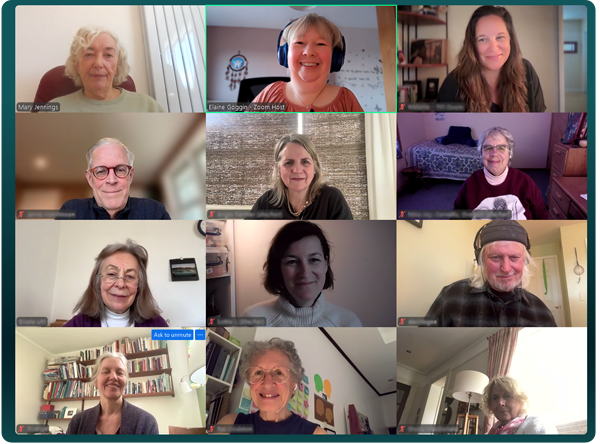
Mary's 3 week course was well received recently with The International Focusing Institute
Worlds of Focusing: Focusing With Your Whole Body
Each Newsletter will explore an aspect of the Focusing World you may not be familiar with. In this edition we will explore the world of Whole Body Focusing.
We are delighted that WBF Trainer Addie Van Der Kooy, took time to write a piece on Focusing with your whole body.
This writing starts with a deep appreciation for Kevin McEvenue, who about 45 years ago, intuitively began combining his work as an Alexander Technique practitioner with his work as a Focusing trainer. He called it Wholebody Focusing (WBF).
For instance, the observation by F. M. Alexander that the body has to come alive as a whole in order for change to happen in a part of the body, has deeply shaped an emphasis in WBF on taking time to become aware of your body as one breathing, living whole, earthed and energised by your larger physical surrounds (ultimately Mother Earth). This then allows your body to become a safe, well-resourced holding space in which to welcome any part needing your Focusing attention.
So, let me briefly take you through what a WBF session might look like.
See yourself as a host preparing yourself before opening the Focusing door to any guests. You first of all take some time to let your body and mind unwind any tensions.
By letting yourself be completely as you are, your mind can come to rest in the Is-ness of each moment.
By simply allowing yourself to feel held by the chair and the ground beneath your feet, your body can also unwind and in that new-found space, it can come alive to its natural energetic connection with the Earth beneath your feet - a ‘six sextillion (that’s a six followed by 21 zeros!) metric ton battery. Not a bad energy supply!
You may also want to welcome a felt sense of anything supportive and nourishing in your surroundings, e.g. day light streaming into your room, a plant or a painting, whatever speaks to you in a supportive and connective way.
If you wish, you can also unwind and resource by felt sensing the flow of your breath, noticing the rhythmic release and ‘emptying out’ (exhale) and the body being re-filled with fresh, new energy (in-breath).
And, given some time, you may also begin to felt sense the ‘Hum of Life’ inside you, a natural sense of aliveness subtly vibrating as an inner energy field throughout your body - a felt sense of being alive and present in this moment, separate from thoughts, feelings, physical sensations and underlying any “packages” that may want some Focusing attention.
You’ve now let your whole body come alive in a new, resourced way; by doing so, you’ve come into a felt sense of You as Alive Presence, an embodied sense of Self in Presence.
You and your whole body are now ready to begin to host any guest that may knock on the Focusing door. There is an embodied sense of You in Presence and there is the alive, whole body into which a felt sense of your guest can be safely welcomed.
There is the fully embodied ‘You’ and there is ‘It’, the Felt Sense, and between the two there is a little distance, space. And in that space a natural interchange may occur which we call Focusing.
Quite often, deeply stored and painful places, like unprocessed trauma, need to feel the aliveness of You in Presence directly within your body. These un-processed ‘felt memories’ are stored in our bodies like time-capsules, carrying the painful ‘unfinished’ past with us into the present moment. And from their past they are reaching out for a body ‘scent’ of the aliveness of You in the Here & Now; it was exactly the absence of Presence at the time of the trauma that caused the overwhelm and subsequent need for ‘freezing over’ of the trauma.
And when you can become aware of a felt sense of the trauma place alongside a felt sense of You in Presence, a special dynamic emerges in which deep healing shifts can take place. In WBF it is called Holding Both with Equal Positive Regard. A previously disconnected trauma wound can now begin to feel itself safely held in relationship to your embodied Presence. This sets in motion a process of Homecoming or Rejoining in which the suffering place can open up and awaken to its own knowing how to move forward in its healing journey.
“When a part of me feels loved, it awakens to its own healing”
- Kevin McEvenue, founder WBF
A Homecoming in Ardpatrick – Spring Gathering of the Irish Focusing Network
by Marta Fabregat
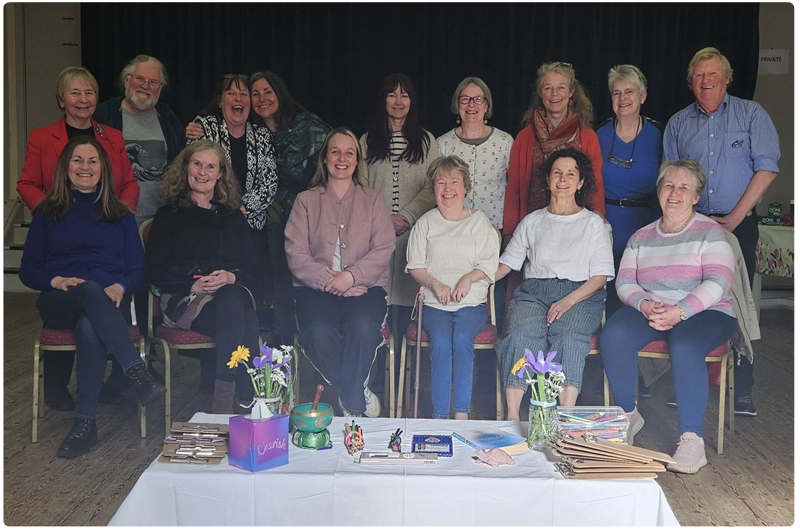
On Saturday, April 5th, 2025, the Irish Focusing Network gathered in the welcoming heart of Ardpatrick, Co. Limerick, for our Spring Gathering, a day filled with rich connection, deep listening, and a sense of coming home.
Hosted at the Ardpatrick Community Centre, the day offered two beautifully held workshops: in the morning, Me and My Best Friend, facilitated by Elaine Goggin, invited us into a gentle exploration of our relationship with the Inner Critic, what it is trying to protect, and how it might be met with curiosity and compassion. Above all Elaine brought us to a place of joyous contact with that aspect of us that loves dearly.
In the afternoon, Rennie Buenting guided us through Finding your Way with Parts, drawing on the practice of Inner Relationship Focusing to meet and listen to the many voices within us with respect and kindness. Rennies workshop brought a sense of beginners mind, like less is more when we are listening to all that is there.
But what truly stood out was something even more powerful that took root: a profound sense of welcome. Elaine’s presence, along with the participation of her family and the wider Ardpatrick community, was woven into the very fabric of the space, creating a feeling that’s hard to put into words. It was as though we hadn’t just arrived at a venue; we had arrived at someone’s home, a place held with care, maturity, and a deep openness to whatever might unfold.
There was a kind of quiet joy in the air, a grounded warmth that made space for new connections and renewed ones, for laughter over shared meals and deep silences in shared practice. Many of us commented on the love we felt, not only from Elaine, but from the land and the people who live there. There was a sense of being received by a well-rooted, vibrant community that has found its own way of living and learning together, open and permeable. As one participant reflected, “I felt like a guest in someone’s home and also like I belonged.” That might best describe the spirit of the day that I am sure for those of us who met in Ardpatrick it will be always a memory that keeps informing us.
A heartfelt thanks to Elaine and her family in Ardpatrick for reminding us of the beauty of Focusing not just as a practice, but as a way of being together in the most gentle and ordinary way.
And thank you to all the wonderful Focusers who were there, making this such an unforgettable day.
Our next In-person Gathering will be in Dublin in the Fall: on the 27th of Septemeber 2025 in the Dublin at the Dominican Retreat Centre in Tallaght.