



Orts by Denise Durocher
|
Orts
|
From the orts,
|
|
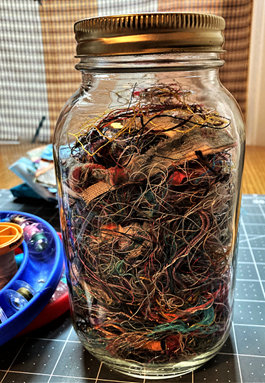
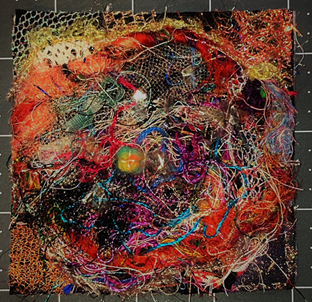
Throughout the years of working with fabric, embroidery floss, scraps, and pieces, I learned that the snippets of threads, bits and bobs, are called “orts”. Reminds me of how I am sometimes before a Focusing session. |
Fibre art piece made from fabric, batting, orts of all sorts, including a soft centre of wool roving, and shiny pieces of mica. Thanks to all the Focusers who have helped me make sense out of my mind’s orts. Denise Durocher |
Being Playful at the Children’s Focusing Conference 2023
The Children’s Focusing Conference was held in early February and it was a conference that I was very much looking forward to. Getting to spend 3 days with like minded people who want to nurture their own inner child, and in turn support children in whatever way they can, was a very exciting prospect. And it didn’t disappoint. There were attendees from all over the world, spanning across 26 different countries and time zones, making the world a very small and connected space. It also highlighted the very different worlds and environments our physical bodies live in. These are the environments that children are born into and hope to survive and thrive in.
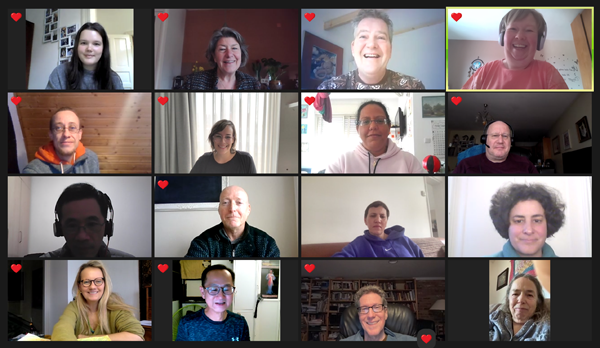
Connecting through Zoom and hearing from the presenters and participants, how they interact with children in different situations either through teaching in a regular classroom or supporting children in foster care, through therapy/counseling or just wanting to be there for their child or grandchildren, expands the heart and creates a huge network of support across the global Focusing community. There was a real sense of sharing and holding for each other over these three days.
The theme for this conference was Moments of Wonder and the first presentation hosted by Luzia Stefan (my room neighbour at the weeklong in Dublin!) began by offering us this:
“All grown ups were once children…but only a few of them remember it”
“By knowing Focusing we have the opportunity to remember and to value the child inside us and inside others”.
This set us up nicely for the coming 3 days! A nice reminder to let our inner child out and run amuck! Personally, my inner child was very happy to take part in all the exercises over the weekend, she’s loves to draw and colour and to allow the meaning of each moment to emerge. A moment of wonder!
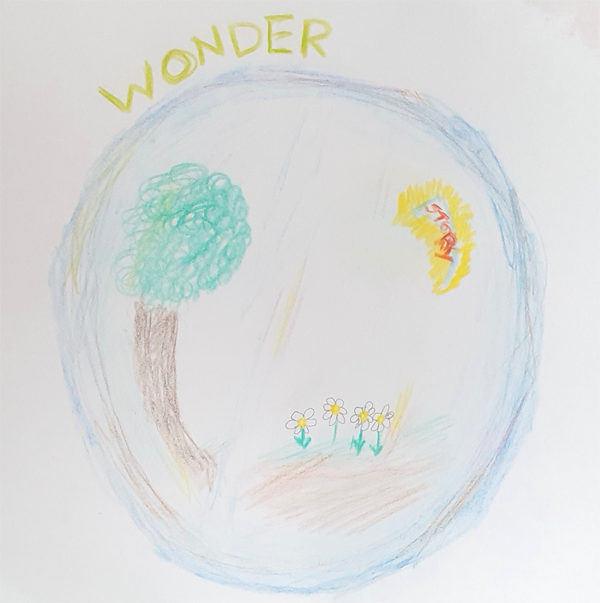 One of my favourite exercises was to create our elevators, that were going to transports us to our inner stories in our body, with the lovely Lucy Bowers. It wasn’t what I expected it to look like and it reminded me of the book from my childhood Charlie and the Great Glass Elevator, as my elevator became a bubble that traveled around having “Adventures in Fairy Land”. Lucy wasn’t feeling very well that day and was assisted by her good friend Susan Watson. And as I write this article for the Newsletter I see an email that breaks my heart a little, as I learn that Lucy has passed away peacefully. I first met Lucy in September 2022 as I assisted with Zoom for her workshop, that she gave so generously in support of TIFI, she had such an infectious personality you couldn’t not immediately love her! I am really glad she made it to the Children’s Focusing Conference that day and we got to be held in her warm and enthusiastic presence one more time. Although I had only met her a few months previous, I find tears flowing softly as I read that email. Rest in peace Lucy, I’m sure you and Gene will have a lot of fun observing us from above.
I’m sure Lucy was really happy to be there in February and was enthused by the ever growing interest in Children's Focusing. It’s so encouraging to see, through the presenters examples how Focusing can help no matter the environment and situation that the child may find themselves in. Rene gave a wonderful presentation around the inner critic that left us wanting more! Throughout the weekend we had lots of opportunities to see how Focusing has helped children, from Dance/movement to Pausing to sensing how it feels from the child’s point of view, how things are heard or received or even held.
Monika Linder gave a lovely presentation called ‘We are each other’s Environment: Imagining a Culture of Moments of Wonder’ She brought us through exercises where we allow our bodies to share with us what we felt and then check if something more comes when we hear what others have shared. The Institute has made this video available to all through their YouTube Channel and it is definitely worth a watch: https://www.youtube.com/watch?v=W30pzpXvxdY.
One of the, if not thee, highlight of the conference was the wonderful presentation from 18-year-old Anna Boukydis. Anne grew up with and very visibly embodies Focusing. Anna’s presentation was incredibly mature and beyond her years. Entitled Kids Now–a–Days, she encouraged us to connect with the inner child within us all, helping us to remember what it was like to be a child or a teenager again, and she described some of the issues that she felt her generation is experiencing and how she deals with it all in a Focusing way.
One clear similarity, that came across during the conference was the recognition of how Focusing can support a child’s inner world so they are better resourced to handle anything the outer world may have in store for them. Having supportive adults who can listen in an accepting and open way can be an essential bridge for them to really find their way in this world, while also being open to, and, creating Moments of Wonder!
Elaine Goggin
You can still sign up and view all the videos from the weekend: https://focusing.org/event/recordings-past-event-moments-wonder-online-children-focusing-conference
Remembering Lucy <3
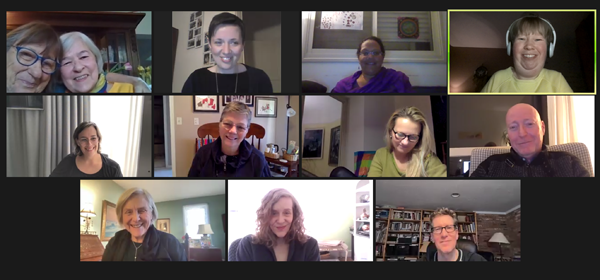
Here is a short video of the lovely Lucy: https://www.youtube.com/watch?v=W30pzpXvxdY
Sensed Ecology - Recovering the green breath as nature beings
Sensed Ecology - Recovering the green breath as nature beings
by Marta Fabregat
I was fortunate to give my first presentation on Sensed Ecology at this year’s Felt Sense Conference.
Sensed Ecology is a term that is in emerging evolution and continues to be evolving in its philosophical findings, which I found fun to start sharing something that I am deeply passionate about and that I live and research in my everyday life through Focusing and TAE.
Whether we are aware of it or not, since childhood we have been conditioned to distance ourselves from the most organic reciprocity with the elements of nature and the relationships of support, exchange, and progression that exist in contact with the ecosystem to which we belong. Sensed Ecology is a term that I am using to describe how there is an innate belonging to nature as human beings and how Focusing is guiding our next steps towards recovering the green breath that we truly are. It is remarkable to notice how Focusing and Gene Gendlin’s deep vision was and still is an ongoing initiation into a conscious relationship with self, others, and the environment that will inspire new steps for forward growth.
From Gene Gendlin's work on Five Philosophical Talking Points (Gene Gendlin’s article Five philosophical talking points to communicate with colleagues that do not know yet Focusing) I found that these 5 points were supportive of my theory in Sensed Ecology and how we can recover the ability to function more as part of the green world we are by reconnecting and aligning our sensing capacity to that of nature.
1. Experiential Intricacy
Ecology opens us to perceive the relationship of organisms to one another and their physical surroundings, including us there. How they interact and how they are finding their next step in the relationship. Pausing - slowing down - noticing - feeling the the aliveness of the whole with us there.
2. New linguistic expressions are possible
A Felt sense implies language, not necessarily our known language but one that is still not in words. It might not even mean that it will be in words as we know them.
3. Interaction is first
As we start noticing and sensing from our experience in the present moment, life happens as being part and with the whole, forward steps start coming from an Ordinary Mind and a greater sense of being alive.
4. Experiencing is intrinsically a valuing
As we interact with our environment and life**, we cross.** Focusing invites us to listen with big ears, big eyes, great contact, and with a subtle sensitivity in our sense of smell and taste...maybe more is there that is leaning towards listening and crossing.
This requires radical humility and compassionate belonging as a new language emerges from the crossing point.
5. Thinking can be at the point of emergence of new forms
Sensing our innate ecology, our ordinariness in living moment by moment in contact with the present moment, it offers a greater landscape to carry forward as part of a greater order of things. From what we say, from what we know and have acquired from our learning experiences in our societies, cultures, and all that is from the implicit intricacy of being alive, new emergent communication, and the co-creative process becomes available for the whole. Interbeing.
This is a call to remember and to become nature, to find out our ceremony, and to legitimate our felt sensing from within our experience. From that place that is guiding us. Reclaiming back our innate relationship with the green world from our bodies in contact with all that is.
STUCK and PAINFUL by Denise Durocher
STUCK and PAINFUL by Denise Durocher
Sometimes, when I do my check-in, something feels stuck in my throat.
I’ve always thought that this is a sign that a particular something, at this particular moment needs to be expressed. The “something stuck” needs a voice.
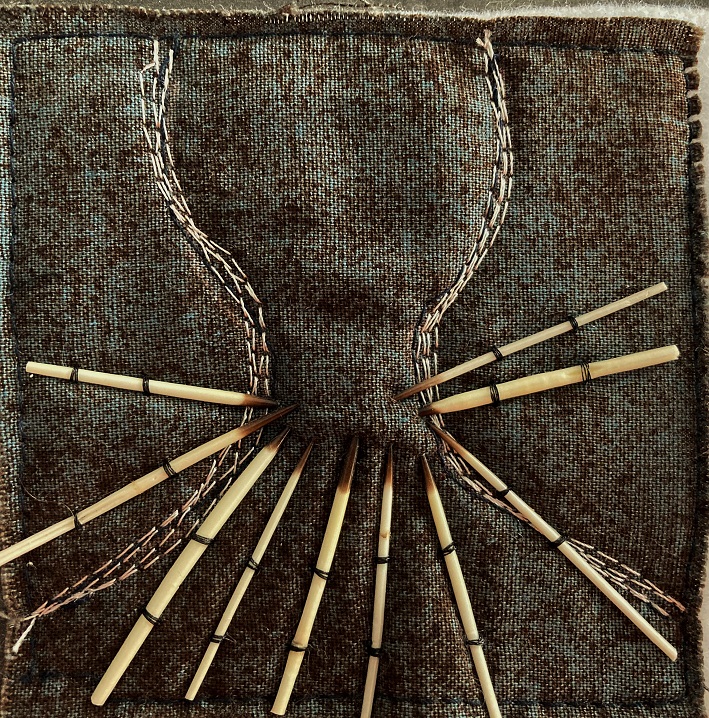
It also feels like there are a bunch of porcupine quills sticking in my throat and they hurt so much, that whatever needs to be expressed, gets discouraged and withdraws in silence…again.
With Focusing, I can tell that scared something that I hear it, that I know it is there, and that with the help of a listening partner, I can slowly remove the quills one by one.
It may take more that one session, it may still hurt, but I trust that the quills will come out and that the voice will be free.
Denise Durocher, Ottawa
Textile art piece:
Hand and machine-stitched fabric, porcupine quills, and embroidery floss.