





Elizabeth English - Journeys to the Deep
Elizabeth English - Journeys to the Deep
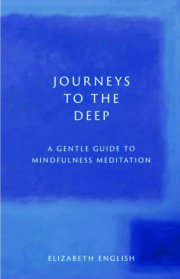
“A long curiosity/struggle with meditation drew me to Elizabeth's Journeys to the Deep and her thoughtful prose and poetry both soothed and encouraged me - yes, I am on the right track; yes, it's OK this is such a personal endeavour; yes, all is well. I immediately ordered copies for a handful of friends, all of whom have shared their own gratitude and enjoyment.” My review on Amazon
I met Elizabeth at the International focusing conference in Cambridge in 2016 and was drawn to her bright infectious energy, yet an energy that was grounded and deep and somehow very wise. I discovered she “holds a ground-breaking post as [Cambridge] University’s first Mindfulness Practitioner” and was intrigued. I followed her online and was delighted to find Journeys to the Deep, the first in a trilogy.
The hundred or so pages are personal, inviting, a mix of poetry and prose, and something I return to, each time finding something new. A nuance, a deeper meaning, something fresh, a blessed aha-got-it, oh, it’s this…. And of course, constantly seeing the influence of Gendlin’s focusing, philosophy and wisdom.
As I offered in my Amazon review above, I felt profoundly reassured that my mindfulness practice was exactly that - mine. However it was, it was OK. It didn’t need to be done a certain way, or bounded by all the other parameters I’ve been taught or read about over the years. Her sweet poetry offered another way in - to wherever it is we go in mindfulness meditation - that was gentle and comforting yet thought-provoking in a bodily way. Less like intellectualising and thinking about what came forth, and more like the body being able to sense in to her words, the spaces between, images, metaphors. A truly delightful experience.
In conclusion, I’ve just read Journeys to the Deep again, cover to cover without much of a break. Well that’s not strictly true, I found myself pausing, looking out of the train window and ….guess what….meditating! Far better to take it one or two pages at a time though, that’s my usual engagement. It’s a book which lends itself to however you want to read it - start at the beginning, or in the middle, at the end, or somewhere randomly in-between. It’s like taking a lovely little break from whatever is going on, pausing as we focusers do, to sense how we are, how things are.
I have permission to share one of my favourites:
For now
Don’t wish for your mind
to be different from how it is;
Water does not boil faster
for glaring at it.
Things take their own time,
and you, too, are subject to
the laws of change.
You can only dip your toes
into the occasional puddles of calm
that collect in the dips and hollows
of your undulating thoughts.
Although a tiny droplet of peace
is all you find, still treasure it;
it is yours, and all you have -
for now.
Clare Myatt, LL.B., M.A.
Somatic Therapeutic-Coaching
Available UK and internationally online
+44 (0) 7894 714853 | This email address is being protected from spambots. You need JavaScript enabled to view it. | https://claremyatt.co.uk
Clare’s book Love & Imperfection: A Therapist’s Story available now
https://claremyatt.co.uk/book/ and from AMAZON
A Fresh Look at Clearing a Space
A Fresh Look at Clearing a Space
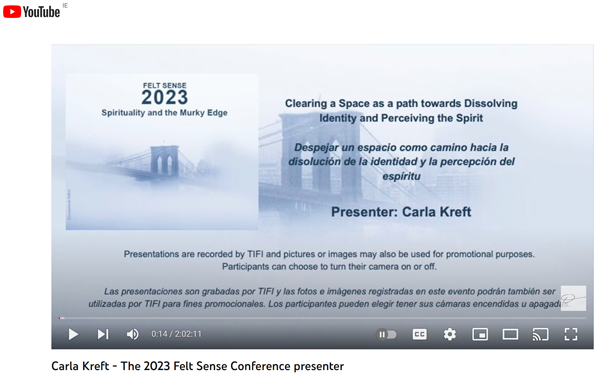
At a recent TIFI Felt Sense Conference, Carla Kreft, gave a presentation entitled, Clearing a Space as a Path towards Dissolving Identity & Perceiving the Spirit.
It was based on her close reading of the topic in Gendlin’s seminal book Focusing. “Couched in this simple exercise, it is possible to develop three different abilities”, she says:
- To experience our problems as an observer of them
- To experience great joy, love and a real sense that everything is really ok in our lives
- To be able to leave behind not only our problems but our entire identities and to ‘perceive the spirit’
The first ability is one that we are probably most familiar with, reminding us that not only this is a good way to start a Focusing session, but it is also worth doing in its own right as a way simply to give ourselves some breathing space.
Carla acknowledged that there might well be some resistance to trying the second use of CAS that Gendlin suggests. She went on to say however that this sense of experiencing joy and that ‘all is ok’ is our natural state.
The third ability, based on disidentifying from what Gendlin calls our Background Feeling, or what in contemplative and psychological practices is often referred to as ‘disidentification’, is one where she says, “if we manage to leave behind our identities then we can potentially enter a state that will permit us to come to what people call the higher self or the spirit”. Gendlin refers to it as encountering a ‘vast space’.
Carla’s presentation is freely available on TIFI’s website. https://www.youtube.com/watch?v=PY3R2OUUrd8&t=3601s
It’s well worth watching, considering and doing the 3 exercises that she lays out in a clear and engaging way. Thanks to Marta Fabregat who did the Spanish translation on the day.
Mary Jennings
The European Focusing Association (EFA)
 The European Focusing Association (EFA) is a European network for Focusers, Focusing professionals and Focusing practitioners, who wish to develop Focusing and the Experiential Approach through collaboration, openness and mutual support.
It is open to all who share the mutual ground of Focusing. The Association has recently launched its new website where you can explore it’s vision and aims. You will find it at https://efa-focusing.eu/
There is also a Facebook group which may be of interest. The ‘European Focusing Forum’ group is an open space for European Focusers to meet others, share ideas and experience, collaborate, get inspiration and ask questions. The group is for Focusing-related topics. Reflections, sharing, articles and quotes that promote and support self-reflection and awareness will be welcome. The group is private, which means that only members can see who’s in the group and what they post.
There is an open invitation to join the group: https://www.facebook.com/groups/efaforum and encourage other European Focusers to join too!
If you’re in the mood for a trip to Italy later in the year, check out the details of the 2023 Gathering in Bassano del Grappa, 25th – 29th October. You’ll find all the information in the February Newsletter here: https://efa-focusing.eu/2023-gathering
And if you would like to stay in touch with EFA, you can subscribe to the Newsletter, by clicking here https://efa-focusing.eu/news/newsletter/
Focusing and Dream Work
Focusing and Dream Work
Eugene Gendlin wrote a book in 1986 – Let Your Body Interpret Your Dreams in which he said, “Love and enjoy the dream whether you interpret it or not” and which included sixteen questions was a way to find the meaning in dreams for oneself. He followed that up with two articles updating the ‘dream book’. Andrea Koch wrote Dreams and the Person-Centred Approach in 2012. There was also a Folio special on Dreams in 1992. Outside of these and a few articles in Focusing newsletters there has not been a lot of overt attention paid to dreams in the Focusing community, especially given Gendlin said that dreams are an excellent means of learning Focusing because they bring with them a fully-formed felt sense … until now that is. Leslie Ellis, a Focusing Trainer and Coordinator from Canada studied dreams, researched the dreams of trauma survivors and wrote the book, A Clinician's Guide to Dream Therapy* which blends Focusing with many other approaches to dreams.
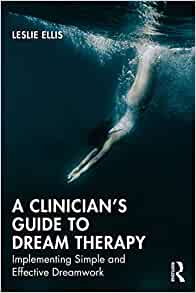 Ellis packs a lot into this book’s 147 pages. Drawing on the insights of neuroscience and current research, including her own, she examines dreams from many angles to provide a clear and concise map for anyone, not just clinicians, to interpret or work with their dreams. In the book she answers the questions as to why one should engage in dreamwork and how best to bring dreamwork into a practice and into life. She makes the point that dream interpretation is no longer the prerogative of a clinician but is now firmly the responsibility of the dreamer possibly with help or/and support of a listener/clinician. Having surveyed all the approaches and theories she outlines a universal approach to working with dreams.
Specifically, she asserts that,
“there is a distinct trend toward experiential methods as the main way of working with dreams. The most popular experiential techniques include telling the dream as if it is happening in the present, dreaming the dream onward, and inviting the dreamer to enter into the subjective experience of a dream character or element … there was almost total consensus that the dreamworker refrain from interpretation of the dream. Instead there was an emphasis on collaborative exploration with the dreamer, and a focus on exploring the emotional landscape of the dream.“
While there is only a short section specifically on the Focusing approach to dreamwork, Gendlin’s approach is frequently referred to throughout the book. She highlights Gendlin’s unique additions/contributions to the panoply of dreamwork approaches and techniques: finding the ‘help’ in a dream and ‘bias control’. The former is a suggestion to look for the ‘life-forward’ energy or life force that is present in every dream and she points to the various forms that such help might take as well as where to find it. The latter is an exhortation to be open to the possibilities in a dream rather than interpreting them based on what we already know. This means exploring and possibly embodying all aspects of a dream including those that may be unpleasant or frightening and not jumping to conclusions about them.
She has an especially helpful chapter on bad dreams in general and nightmares in particular, including those affected by PTSD. She shows how confronting or being able to be with the most frightening aspects of dreams has a de-escalating effect on the dreamer and that among other methods, finding the inherent life forward energy can help greatly to alleviate uncomfortable symptoms brought about by these dreams. She gives many examples of dreams and their explorations here and throughout the rest of the book which illustrate clearly the benefits of making the space and time to remember and work with dreams in an open, curious and compassionate way.
My experience of bringing this type of Focusing-oriented approach to my own dreams has been a very interesting and enlightening one. I found the suggestions in the book enormously helpful, including one where she suggests that this process works really well when people tell and explore their dreams in pairs as in a Focusing partnership or in small groups.
*A Clinician's Guide to Dream Therapy: Implementing Simple and Effective Dreamwork (2020) by Leslie Ellis is published by Routledge.
Leslie has a very interesting and helpful website with articles, videos and podcast on various aspects of dreamwork: https://drleslieellis.com/